
Evaluating the Numicon system as a tool for teaching number skills to children with Down syndrome
Does Numicon help children with Down syndrome to learn about numbers and to and calculate? Do some benefit more than others? Does it need adapting?
Nye, J, Buckley, S, and Bird, G. (2005) Evaluating the Numicon system as a tool for teaching number skills to children with Down syndrome. Down Syndrome News and Update, 5(1), 2-13. doi:10.3104/updates.352
Introduction
This article reports on the findings of a study which has begun to evaluate the use of the Numicon scheme for teaching number skills to children with Down syndrome. Many children with Down syndrome currently have difficulty learning adequate number skills in the classroom to prepare them for everyday life in the community, [1,2] and these new techniques, based on a visual approach to the number system, potentially provide a valuable contribution to the range of teaching advice we currently recommend.
Numicon - a visual approach to teaching number skills
Numicon is a multi-sensory scheme designed to teach number to typically developing pre-school and primary school children. [3,4,5] It is based on the work of a number of authors who emphasis the role of visual representations of number in the design of materials which allow children to see the relationship between numbers. [6-9] Given the visual strengths of many children with Down syndrome [10,11] it is thought that Numicon may be an effective aid for them in learning number skills.
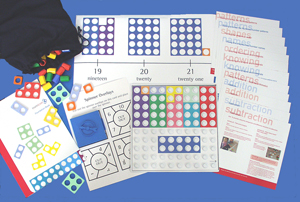
Figure 1. Numicon materials
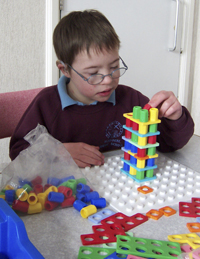
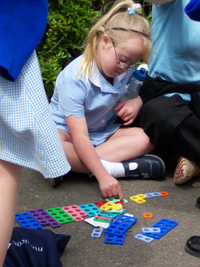
Numicon materials (see Figure 1) use structured visual representation to make the number system both visual and tactile, and to make clear the stable order of the number system (i.e. that the 'next' number is 'one more') and how different numbers are related (e.g. 4 = 2+2, or 4 = 1+3). The materials include coloured plastic shapes, coloured pegs and baseboards, which fit together, and allow children to explore the relationships between numbers. The shapes represent numbers from 1-10, with each shape being 'one' bigger than the previous number (see Figure 2). In addition, each shape is a different colour to aid the children in learning the shapes and being able to represent them mentally. One of the key features of the scheme is that it provides children with visual representations of whole numbers which help to develop a mental imagery for numbers, which in turn supports mental arithmetic. This is done by using the structured materials in multisensory play activities. The scheme itself has a clear structure and step by step teaching guide to enable easy use, and all activities are linked to the National Numeracy Strategy, [12] which provides a standard numeracy curriculum for students in primary education in England and Wales.
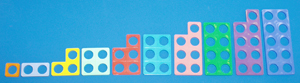
Figure 2. Numicon shapes 1-10
Research has found that typically developing children's SATs results (national Standard Assessment Tests in primary schools) improved markedly after using Numicon, and the children's number concepts were richer and more firmly established. [13]
Numicon and Down syndrome
Initially, some parents tried using Numicon with their own children with Down syndrome at home. [14,15] These case studies indicate that Numicon really did help the children to progress. This provided a clear need to conduct research into the effectiveness of the methods when used with children with Down syndrome in the classroom.
A small pilot study has been conducted following the number skills developed by 11 pupils with Down syndrome aged between 8 and 13 years in Wiltshire, UK, with their teachers and assistants using the Numicon materials and approach. [16] On average, the children made 5 months progress on a standardised numbers skills assessment (British Abilities Scale II, Basic Number Skills scale) over the 4 months of the study. Although one child did not make any progress during the four months, another made a remarkable 11 months progress in just 4 months. (It should be noted that the child who made the most progress also received considerable support in using Numicon at home as well as at school, however 2 other children in the study made similar gains of 10 and 11 months each). These findings reflect a considerable achievement, as a recent 2-year longitudinal study of primary school-aged children with Down syndrome showed that the children made just 4 months progress on average on the same number assessment in one year. [17,18] While there was again a wide range of progress, none of the children in the 2 year study made the amount of progress made by some of the children who had used Numicon in the Wiltshire study.
The results of the Wiltshire pilot study, [16] along with anecdotal and case study reports, [14,15,19,20] indicated that the Numicon system deserved further and more detailed evaluation as a tool for teaching number skills to children with Down syndrome.
The Portsmouth Numicon Project
With this in mind, Down Syndrome Education International was able to secure funds to conduct a one-year, in-depth evaluation of the Numicon system as a tool for teaching number skills to children with Down syndrome and to provide practical suggestions as to ways in which the implementation of the scheme can be improved. We predicted that the Numicon system was likely to require some adaptation when used with children with Down syndrome and we are currently working on a booklet describing practical strategies for adapting the materials based on our experiences with the children and schools involved in the research study. This article details the results of the evaluation study which has aimed to investigate whether children who have used the Numicon scheme will have improved their number skills to a greater degree than children who have not been taught numeracy using this technique, and in particular if or how it needs adapting for children with Down syndrome.
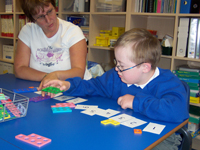
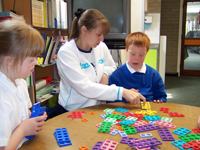
The children
The Numicon group
We contacted the families and schools of the 11 children with Down syndrome attending mainstream schools in Portsmouth and asked whether they would be willing for the children to participate in the study. All of them agreed. The invitation to participate was also extended to the two special schools for children with learning disabilities in Portsmouth (one of whom declined to take part) and a further mainstream secondary school just outside the Portsmouth LEA area. This enabled us to follow as many local children as possible, to increase the number of secondary school-aged children from 2 to 5, and to maximise the range of schools involved in the study.
In total, 16 children with Down syndrome, aged between 5 and 14 years, attending 10 different schools, participated in the study. Of these, 14 attended mainstream schools and 2 attended a school for children with moderate learning difficulties. Some of the children (5 out of 16) had used the Numicon materials before, with some working through the activities following the Numicon teaching structure and others using the materials in a more unstructured way to support their numeracy work.
The No Numicon group
Between 1994 and 1998 Angela Byrne, also at Down Syndrome Education International, followed 24 local mainstream school children with Down syndrome, collecting data regarding their speech, language, reading and number skills. [17,18] As a group, these children had very similar developmental profiles to the children participating in the current Numicon project (see Matching the groups below). Whilst they had received regular differentiated numeracy lessons (pre-National Numeracy Strategy), no specific details of the content of these lessons was recorded at the time. What we do know is that they did not use Numicon. It was therefore decided that they would provide a useful comparison group and so many of the same standardised assessments were repeated in the current study as had been used in the original 1994 study. This meant that comparisons could be drawn between the two groups in terms of the amount of progress that they had made in numeracy skills, with one group using Numicon (the 'Numicon group') and one group not using this method (the 'No Numicon group').
Collecting the data
1) Sub-tests from the British Ability Scales (BAS) [21]
- Basic Number Skills
- Word Reading
- Recall of Digits to measure auditory short-term memory
2) The British Picture Vocabulary Scale (BPVS) [22] to measure receptive vocabulary
3) The Test of Reception of Grammar (TROG) [23] to measure understanding of grammar.
(In order to make comparisons with the archive data we did not use the most recent editions for some of the standardised tests.)
The 16 children in the Numicon group were assessed between January and February 2003, using a range of standardised tests (see Box 1), including a number assessment, which could be compared with the archive data from Angela Byrne's study. Data was also collected on whether the child was already using the Numicon scheme in school or at home, and if so, how long had they been using it and what point in the scheme had been reached. The children completed the assessments again at the end of the year.
In addition to the test data, teaching sessions were observed regularly throughout the year and school staff kept daily records about the children's use of Numicon. Feedback on the use of the scheme was collected from school staff at the end of the project.
Training of school staff and parents
During the year, workshops were run in January and September by Dr Jo Nye and an external Numicon advisor. These workshops allowed both staff and parents to receive training in how to use the scheme and to introduce the research project. Where staff were unable to attend the workshops, Jo provided one-to-one in-school training.
The initial training workshop was so successful that we decided to run additional support workshops in the Spring, Summer and Autumn terms. These workshops were used to find out how the staff were getting on with the scheme, to solve any difficulties they were having and to share ideas between the school staff. In the final workshop they were asked to give detailed feedback on the scheme.
Using the scheme
Teaching staff were initially asked to use the Numicon materials and activities for 10-15 minutes each day, starting at the beginning of the Foundation scheme and working through the activities in the specified order. If children had already used the scheme they were also asked to start at the beginning of the Foundation scheme in order to check all activities had been well learnt and to ensure consistency of the use of the materials.
Adapting for individuals
As the year progressed variations in a) the amount of time spent on the activities and b) how the activities were used, were introduced to reflect the needs of the individual children. Recording how this was done was a key aim of the study, providing the in-depth information needed to see how the scheme might need adapting for children with Down syndrome.
Provision of equipment
Numicon kits
All schools who did not already have the Numicon equipment were supplied with a kit (to cover the Foundation and Year/Kit 1 stages of the programme). Throughout the year the schools were provided with additional pieces of Numicon kit where needed. In addition, table-top Numicon number lines and playing cards with Numicon images on them were provided for the children to take home during the summer holiday.
Recording folders
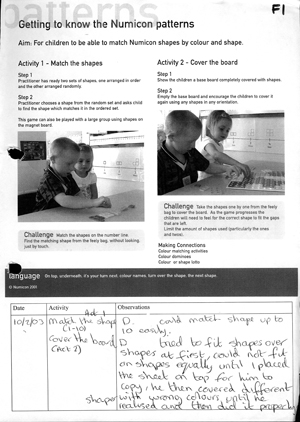
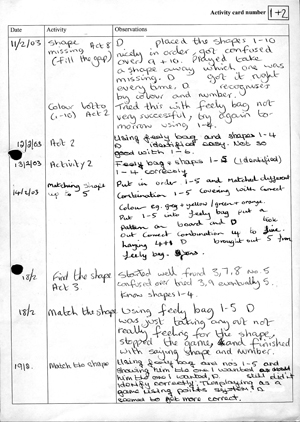
Each child was given a folder for his or her assistant to record the details of each Numicon session they took part in. In order to make this as easy as possible for them, the folder contained a copy of each Numicon activity card followed by a set of sheets with the headers: date, activity and notes (see Figure 3 for an example). This enabled the teaching assistant to have the activity they were working on clearly marked ready for each session; to have that activity's instructions in front of them while conducting the teaching session; and then to be able to easily record the date and notes on that session on the sheet following the activity card. All folders contained the Foundation stage activities to start with, and when the students had worked through these activities the schools were given the next set of activities - Year/Kit 1. Staff were asked to record the details of the activity including any adaptations and extensions, how successful the child was and any difficulties they encountered. This also provided a record of how often each activity was repeated, how often the Numicon sessions took place and in some case how long the sessions lasted.
Observational visits to schools
Jo visited each child 3 or 4 times each term to observe the child and his or her teacher or assistant working together using Numicon. During each visit the classroom assistant/teacher was asked to do what they would usually be doing with the lesson if the researcher had not been there. Thirteen of the 16 children were also filmed during the final visit. In addition to making observational notes, Jo checked that the staff were happy with what they were doing, and offered support and guidance on how to follow the scheme correctly, or discussed any difficulties the staff were having. Often staff would ask for guidance on which activity to move onto next, and in the early stages, would check that they were working through the activities at a suitable pace.
The findings
The findings include both quantitative data (e.g. scores from standardised measures) and qualitative data (e.g. detailed records, observational notes and feedback from teaching staff).
In the statistical analysis of the quantitative data only the results of those children who attained a score on the BAS Basic Number Skills scale at both test points could be analysed, so the data from the children who scored zero at one or both test points was not included. This meant that 12 children's results were analysed in the Numicon group compared with 18 children in the No Numicon group.
Matching the groups
When conducting this type of research it is important to 'compare like with like' otherwise it is impossible to know what has caused any differences that might be revealed between the two groups. For example, if the children in the Numicon group were significantly older, had higher non-verbal mental ages, or better memories, these factors may help the children to progress more quickly with their number skills. If this were the case, their accelerated progress, relative to the No Numicon group may have little if anything to do with the use of Numicon. For this reason, it is important to 'match' the groups on as many variables as possible.
Statistical analysis of the results of the standardised tests conducted at the start of the study showed that the two groups of children did not differ significantly with regard to their BAS Number raw scores or age equivalent scores, BAS reading raw score, BAS digit recall raw scores, or BPVS scores. There was also no statistically significant difference between the chronological ages of the two groups of children, although the children in the Numicon group did tend to be slightly older. There was no significant difference between the groups in the number of months which elapsed between the two test points.
The only identified difference on the available measures between the groups was on TROG raw scores, with the No Numicon group achieving significantly higher scores than the Numicon group at both test points. Therefore, it should be noted that the children who used Numicon were at a significant disadvantage for receptive grammar, and this could be important as language is a possible contributor to progress in some numeracy skills. [24]
Despite the difference in receptive grammar, the two groups were considered to be well enough matched for a meaningful comparison of number progress to be made between the groups. Since it was the No Numicon group who had the higher receptive grammar scores, if better progress was made in number by the children using Numicon it could not be said to be influenced by their better language processing abilities.
Progress made on number skills
In order to determine whether the Numicon scheme improved the children's number skills to a greater degree than differentiation of the standard numeracy curriculum, analysis of the BAS Basic Number Skills measure was conducted (on both raw scores and age equivalent scores).
The results indicate that both groups of children made significant progress with their number skills over the year. On average, the children who did not use Numicon gained 5 months on the BAS number measure over the year. There was a wide range in the amount of gains made with one child gaining 16 months on the test, and at the other end of the range one child performed more poorly at the second test point than the first and so 'lost' a month in their age equivalent score. In comparison the average gain made by the children who had used Numicon was 5.83 months (a 17% greater gain than that made by the No Numicon group), with the highest gain being 14 months and again one child in this group performed more poorly on the test at the second test point, 'losing' 2 months.
| Time 1 | Time 2 | Change from Time 1 to Time 2 | |
|---|---|---|---|
| No Numicon group | 50.33 (41 - 64) | 55.33 (44 - 80) | 5.00 (-1 - 16) |
| Numicon group | 49.17 (38 - 74) | 55.00 (38 - 74) | 5.83 (-2 - 14) |
Table 1: Mean (and range) of BAS Number Scale age equivalent scores (months) at the two test points for each group, plus the amount of change made
The results suggest that the children in the Numicon group made slightly more progress than the children in the No Numicon group over the year. However, this difference did not reach statistical significance, and therefore could be a chance finding. Statistical tests were also run which took the difference in receptive grammar scores between the two groups into consideration. However, this analysis also found that the positive gain was not statistically significant. (An article with more detail on these results is due to be published in a forthcoming issue of the journal Down Syndrome Research and Practice.)
Limitations of quantitative analysis
The results from the standardised assessments are considered to have significant limitations. Most important was that the BAS Number Skills scale was not felt to always accurately represent what the children were able to do in their day-to-day maths work as observed by Jo and reported in records by teaching staff. Many of the BAS Number Skills scale test items involved a level of language and short-term memory processing which was too complex for the children, in terms of vocabulary, grammar and length of sentences. Teaching staff present during testing often commented that if instructions were modified, either using shorter sentences or different vocabulary, the child should have been able to pass an item they had failed. While language is considered to play an important role in number skills in everyday life, the authors considered that it plays too great a role in this test and that the measure was not necessarily identifying number skills in a useful way for the current study. In addition there are sometimes large conceptual gaps between items, meaning smaller amounts of progress in numeracy skills were not always detected.
There were also large variations in the abilities of the children at the start of the study and in their individual needs, and large variations in the way and the frequency with which the Numicon materials were used in lessons. The Numicon scheme was often adapted to meet the needs of the individual child, and exploration of this was another important aim of the study.
In addition, we are comparing very small groups of children, and where each group has such a wide range in scores it is difficult to identify a real effect using statistical analysis.
Therefore, as the standardised data has these limitations, individual case studies of the children's experiences and progress have also been explored.
Individual differences
The 16 children taught using Numicon were ordered in terms of the amount of progress they made during the study on the BAS Basic Number Skills scale.
The results from the No Numicon group indicate that the children might be expected to make approximately five months progress in one year with their number skills. With this finding in mind the children in the Numicon group were split into two groups, those children who made five months progress or more, and those who made less than five months progress.
When the results were examined in these groupings, the following patterns were revealed. (N indicates the number of children the observation applied to.)
The children who made less progress than expected (N = 7) had one or more of the following characteristics:
- The assessments on standardised tests were not considered to be an accurate representation of the child's number skills. This conclusion was based on observations made of the individual children's skills displayed during lessons by Jo, and supported by comments made by teacher staff who were present during testing (N = 6)
- They did not receive regular teaching sessions using Numicon (N = 4)
- They had additional difficulties such as behaviour, hearing difficulties or English was their second language (N = 4)
- They already had good number skills, so the Numicon Foundation activities did not extend their skills (N = 1)
However, it should be noted that many of these children still made good progress on the Numicon activities, and in general number skills over the year. The progress they made was not reflected in their BAS scores either because the steps in the BAS items are too large to capture this progress, language limitations prevented success on the test or they underperformed on the day.
The children who made more progress than expected (N = 9) had one or more of the following characteristics:
- Regular exposure to the Numicon activities (N = 8, plus 1 for part of the year)
- Experienced creative teaching, where the Numicon activities were adapted to fit the interests of the child, and extended beyond the basic activities described by the scheme (N = 8)
- Were often at the stage of learning to add and subtract (N = 7)
- Were often particularly interested in number work (N = 5, plus another 1 for part of the year)
- Were underachieving on number work at the outset therefore the activities extended their skills (N = 2)
It is important to note that the majority (7 out of 9) of the 'high-achieving' group had progressed through the Numicon Foundation activities to a stage where they were working on addition, subtraction or beyond. The average gain made on the BAS Number scale by these 7 children was 9 months (with a range of between 5 and 14 months).
Some of the children who made less than 5 months progress also experienced some of the 'positive' points described, and some of the children who made more progress than expected also experienced some of the 'negative' features described. However, there are few of these and it is felt that the above 'model' accurately represents the overall picture seen, and that these are the important factors to be born in mind when implementing the scheme.
Feedback collected at final support workshop
As well as the assessments and observations made of the children, the teachers and teaching assistants were asked to provide feedback on the scheme in the final workshop. Tables 2 and 3 illustrate the positive and negative aspects reported, and these issues are discussed in further detail below. Overall feedback was very positive and 9 of the 10 schools involved said they would continue to use Numicon after the end of the study. One school was not going to continue to use it, but only as the pupil with Down syndrome at the school was now working on differentiated maths lessons, and no longer needed Numicon to support this work.
| Counting and understanding basic numbers |
|---|
| 1) Clarifies the concepts involved in numbers. |
| 2) Differentiation between -ty and -teen numbers (these are often confused by the children, possibly due to the very similar sound) - using the shapes can easily/visually represent the difference between the two. |
| 3) Count sequence has really been extended (e.g. for this child he could only count to 10 at start of study and now he can count to 100). |
| 4) Development of concept of numbers to 10. |
| Maths steps are made clear |
| 5) Odd and even numbers are clearly represented by Numicon shapes - thought that child in question may not have understood concept of odd/even without this. |
| 6) Adding - this is clearly represented by combining the shapes (and answer can immediately be seen without counting, once shapes are known to the child) |
| 7) Number bonds - are clearly represented and learnt using the shapes. |
| 8) Doubles - again these are clearly represented using shapes. |
| Money |
| 9) Money - this has really helped exploring how each coin represents a different value, by matching with the Numicon shapes. |
| Importance of visual and multisensory aspects |
| 10) Visual aspect to scheme makes it very useful, and works for the children. |
| 11) Being able to feel the shape gives another aspect to the experience (multi-sensory). |
| 12) Shapes - have developed an interest in them. |
| Fun material |
| 13) The materials are very interesting to the children; they want to take part in activities and explore them spontaneously; the children enjoy it; it's fun. |
| Adaptable |
| 14) Versatile - can adapt activity to suit the needs of the individual when working with a group. |
| Progress and child's intentions are made clear |
| 15) Can really see progress being made by the child. |
| 16) Not needing to write to respond. |
| Useful for other children |
| 17) Has proved useful to other children in the school with maths delays (e.g. those on the SEN register). |
| Useful for planning teaching |
| 18) The structure of the activities was very useful for the teaching assistants to help them plan activities and know what to do next - it enables them to work out a whole lesson plan for each goal (which is specified on the card) and work through it at the child's pace (rather than class pace). |
| Other spin off skills |
| 19) Turn-taking has improved (many of the activities utilise turn-taking), and improved listening skills (e.g. listening to other to know what to do on your turn). |
| 20) Improved independence. |
| 21) Fine motor skills have been improved in some children through manipulation of shapes/ pegs. |
| 22) Has improved self-esteem - they are able to do it, so they are happy to have a go. |
| 23) Developed other sensory skills - including colour knowledge. |
Table 2: Feedback on the Numicon scheme from teaching staff - positives
Positives in more detail
It is important to note that many of the positive points reported are key aims of the scheme and may apply to any child, not only those with Down syndrome.
The Numicon materials clearly represent concepts involved in numbers in a visual and multi-sensory way (Points 1-13)
These points support the reasoning behind using these particular materials with children with Down syndrome and for any child who has a visual learning style, or is struggling to cope with the standard maths curriculum in its current format.
The children developed new concepts and skills (Points 3-8)
Many of the assistants and teachers had been working with the children for several years and knew them well. Once they started using Numicon they often observed the children demonstrating an understanding of number concepts that they had not seen before.
Particular areas that materials supported (Points 1-9)
The following were identified as concepts that the Numicon materials had been really useful in teaching: concept of numbers to 10, adding, number bonds, doubling, odd/even numbers, money, drawing attention to the difference between -ty and -teen numbers, extension of number sequence. Many of these topics, particularly those involving basic concepts of number and calculation, are emphasised in the Numicon teaching scheme, however the last three items are worth considering in more detail.
Production and/or understanding of -ty/-teen numbers (Point 2)
Numbers ending in -ty and -teen are often confused at some point by most children. This can be a more persistent difficulty for many children with Down syndrome, and can be addressed using the Numicon materials. When the children used the shapes to represent the numbers staff could identify when they were not hearing or not understanding the difference between numbers (e.g. 14 and 40). They could then use the shapes to work on these numbers. In addition, use of the shapes by the children to represent their answers to maths problems indicated understanding which was not always clear in their spoken responses (e.g. when -teen and -ty numbers were not clearly differentiated in child's speech).
Production of the count word sequence (Point 3)
In the Numicon scheme, extension of the count word sequence (i.e. the ability to recite numbers in the correct order, e.g. "1, 2, 3, 4….") is addressed on one activity card (Activity Counting 1a, in the Year 1 scheme), with the aim to extend the count word sequence to at least 50 and then on to 100. For many children with Down syndrome, acquisition of the count word sequence is a skill that usually takes longer to acquire than for typically developing children, therefore it often needs to be a specific target for parents and teaching staff to work on. As this is minimally targeted in the teaching scheme itself, it is perhaps surprising that one member of school staff highlighted this in their feedback, however this was mentioned in the initial training workshops as an aspect that was not covered in the Numicon scheme and, for some children, may be a specific target.
Money (Point 9)
Using Numicon to support understanding of money is covered in one activity in the Year 1 teaching scheme and the Kit 2 teaching book, however there is an expectation that most children will have an everyday knowledge of money that they bring to the activity, which is often not the case with children with Down syndrome. Therefore, this activity was broken down into smaller steps with learning to recognise the coins, etc. added into the activity where necessary.
Materials are motivating (Point 13)
Comments such as these were very frequently reported by the teaching staff during Jo's observation visits to schools, and all the children were found to immediately engage with the materials. Some of the children did not always want to do the specific Numicon activities, but all were eager to manipulate the materials from the outset. This is obviously a very important point in getting children involved in their numeracy work.
Clear teaching structure (Points 14 and 18)
The way that the teachers and classroom assistants worked with the children varied across schools. In some schools the teaching assistant working with the child was very much responsible for the child's learning and lesson content, with very little support from class teachers or SENCOs. Where this was the case the teaching assistants reported that the Numicon teaching scheme was invaluable in giving them a clear well-structured curriculum with appropriate activities to work through. In schools where the teachers and assistants worked more as a team, the Numicon scheme was also valued for providing an appropriate curriculum for the children, as most needed significant amounts of differentiation of the maths curriculum. As well as having a clear structure it was reported that the materials and activities were versatile enough to be easily adapted for the different needs of individuals in a group of children.
No need for child to write responses (Point 16)
During the Foundation stage of the scheme there is very little record keeping to be done by the children, all the activities are conducted by manipulating the materials and numeral cards. Many of the children were not fluent writers therefore this approach was very helpful in that they could focus on the activity in hand rather than spending long amounts of time attempting to write sums or answers. In addition, the children could use the materials to express their thinking, and assistants could identify errors in the children's understanding, all of which were often difficult for the children to express verbally. For some of the schools the lack of a piece of written work at the end of the lesson was a problem. Solutions such as the assistant recording what had been done, producing paper copies of the shapes or photocopying work on white boards, which could be pasted into workbooks were suggested. It is not until the Year 1 stage of the Numicon scheme that more traditional recording work is introduced.
Useful for other children in school (Point 17)
One school started using the Numicon activities as a small group activity with the child with Down syndrome and two other children who were on the SEN register for maths, both to benefit the child with Down syndrome in working with other children and because they thought the materials would help the other two children. All three children got on well with the materials and the two teaching assistants used the materials in a very creative way in combination with a range of other resources. After a short time one of the children without Down syndrome was found to have a real breakthrough in her understanding and was able to return to the main maths class again. So in this case Numicon seemed to have really boosted the child's understanding of number and maths, appealing to her style of learning and enabling her to access the style of maths work presented to the class. The child with Down syndrome and the other child with number difficulties continued to work together for the remainder of the year, and both were observed to make progress in their number skills. The one special school participating in the study also made use of the materials with other children in the school and reported that many of the children were finding the materials useful.
Improvements in skills other than numeracy (Points 12, 18-22)
Whilst it cannot be certain that using Numicon was directly responsible for all these developments, the teaching staff did feel that the Numicon activities benefited some of the children more generally. For example, several children were reported to have improved their fine motor skills during the year, and this was felt to be due to manipulation of the shapes and pegs. Whilst the materials were sometimes found to be too difficult for the children to manipulate to start with, they were motivated to persist and hence improved their skills during the year. For some children their confidence and self-esteem at attempting numeracy work was boosted, as they were able to succeed in an area where previously much was not understood or they were unable to communicate their thinking. At the start of the project one child did not know the colour names and so a specific set of activities was set up to teach this set of vocabulary to him, and for many of the other children the range of colour words was beyond their current knowledge and so this was extended by working with the shapes.
Difficulties
Table 3 shows some of the difficulties that the teaching staff reported with the scheme for the children with Down syndrome.
| 1. Steps in activities are possibly too large - each activity needs breaking down more. |
| 2. Child is stuck on making shapes with pegs - pegs always end up in a row (this was the case for two children). |
| 3. Feely bag is very difficult or aversive for some. Similarly some children find using playdough/plasticine aversive so Foundation Activity 18, which uses these to make numerals, was difficult for them. |
| 4. Fine motor difficulties - they avoid using the pegs and just do activities with shapes. |
| 5. Concern that Cuisenaire rods are different colours to Numicon shapes, and whether this is going to confuse the children or make using them more difficult. |
| 6. Getting the whole school to see the scheme might be useful, for other children may be difficult - in one school it is seen as a 'Down syndrome' activity. |
| 7. The conflict between working through the Numicon activities and working with the class activities (mainstream class). |
| 8. Where to do Numicon - in class or outside?; Using the Numicon kit in class - possibly distracting to other children. |
| 9. Transfer of skills - from Numicon activities to other activities not seen. |
| 10. Record keeping (for research project) - difficult to do to make sense for others to read. |
Table 3: Feedback on the Numicon scheme from teaching staff - difficulties
Numicon activity - large steps (Point 1)
A commonly reported difficulty, and one that was expected at the start of the study, was that as the Numicon scheme has been designed for typically developing children the activities are in relatively large steps. Some of the children with Down syndrome, especially the older ones, were able to work through the activities as they are presented, and one of the most able understood and completed each activity in one lesson. However, most of the children needed the activities breaking down into smaller steps. The teaching staff varied in their confidence in doing this and many sought further guidance.
Children stuck on certain activities (Point 2)
Two of the children in the group had particular difficulties in creating the patterns with the pegs, and rather than making the patterns they would put pegs on the board in single lines. The staff were encouraged to not worry too much about these activities and to work further with the other activities involving shapes, occasionally returning to the peg activity.
Feely bag (Point 3)
Some of the activities involve the use of a drawstring or 'feely' bag in which shapes are placed and the child has to put his or her hand into the bag and feel and possibly name or describe the shape before taking out of the bag. One of the key reasons for this activity is to help the children to 'see' the patterns in 'their mind's eye' and go on to develop mental images of the shapes. The aim is to develop concepts of whole numbers and patterns. The children will then be able to manipulate these images mentally, and so reduce reliance on using concrete materials when calculating. However, for some of the children putting their hand in a drawstring bag was aversive (e.g. fear of unknown inside bag, or physical feeling of material), and for other children the activity was very difficult. A range of successful solutions were tried, including using a box with a lid if the bag was aversive, and if the task itself was too hard then reducing the number of shapes in the bag to a minimum (one or two of the most well known shapes). Other children were unable to take part in Activity 18 which involves creating numerals from plasticine/playdough due to an aversion to touching these materials, so other multisensory activities that were acceptable to the child were suggested (e.g. tracing numbers in sand, writing on a whiteboard, making numerals out of sticking paper or sticking on small pieces of pasta/popcorn, etc.), and all of these would be useful ideas for all children to try.
Fine motor difficulties (Point 4)
As has been discussed previously (see section on positive comments) some of the children had great difficulty in manipulating the materials, with the pegs causing the most difficulty and frustration. Solutions included getting the teaching assistants to manipulate the pegs whilst the child added the shapes, or to focus on activities using the shapes and allow the child to have some 'free-play' time with the pegs where there was no pressure to achieve a certain goal. As discussed earlier most of the children persisted in using the materials, and their skills in using the materials developed over the year.
Colour of Numicon materials vs Cuisenaire rods (Point 5)
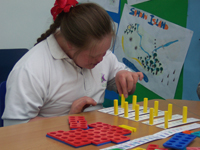
Some of the children had started to work on Year 1 activities, which make use of Cuisenaire rods (see Figure 4). Some schools already had sets of rods and others were given the sets being produced by Numicon. In all cases the colours of the rods were not the same as those used in the Numicon shapes, and some teaching staff were concerned that this would confuse the children. However, the teachers who developed Numicon, stress that this should not be a problem, partly as the colours are only there as an aid to start with when using the shapes or rods (gradually the children get to see and use the patterns). Over time it is considered unhelpful if a colour always represents the same number. [22]

Numicon being seen as a special needs activity (Point 6)
Many of the staff using the materials thought that they would be a useful resource for a whole range of children, however they thought that Numicon was starting to be seen in their schools as an activity only associated with the child with Down syndrome and was therefore starting to be perceived as 'a special needs resource'. They perceived that this could be a problem both in terms of teaching staff not realising that it could be a useful resource for all children, and in terms of other children not wanting to use the materials. In schools where the materials are available for all student to use, or are used in small group settings this problem has not arisen. Training for the whole school may also prevent such difficulties, to make clear that the scheme was originally developed for all children and that there is evidence to support the benefits of its use in mainstream schooling. [12]
How to integrate the scheme into the current school practices (Points 7 and 8)
Some teaching staff reported difficulties in balancing the need to work through the Numicon structured activities in order with the need to include the child with Down syndrome in the class lessons. An ideal situation would be for the whole class to be using the materials, however this was not the case in any of the participating schools. Use of the Numicon scheme by all children in the school is most likely to occur in an infant school, as the current Numicon scheme is designed for Reception through to Year 2 at present. The gap between the Numicon scheme and the standard junior and secondary level maths curriculum gradually widens and the possibility of difficulties in using the scheme are more likely, but by no means inevitable.
Different solutions to this were found by the different schools depending on the needs of the individual children, wishes of the parents and the philosophy of the teaching staff and school. For example, for many of the children to access the maths lesson significant differentiation needed to take place, and so the staff were happy to use the Numicon scheme, seeing it as a crucial way of providing the child with useful numeracy skills. Other children spent part of the lesson doing specific Numicon activities, often for 10 minutes while the class was doing mental maths activities, and then joined in with the rest of the lesson, using Numicon shapes to support where they could.
Connected to this was the dilemma that some schools had in the location of where the Numicon activities should take place. One concern was that using the materials or being engaged in a different activity from the main class would be distracting for the other children, therefore often the activities were conducted outside of the classroom in a quiet area, and this is where for some schools the dilemma between the need for inclusion and the need to teach useful numeracy skills appeared. For some of the schools this was not an issue as they did not have other areas to work in and in one case the teenager with Down syndrome would not work outside his class, so the activities were done in the classroom and apart from some initial interest by the other children this was not found to be a problem.
Lack of transfer of skills (Point 9)
One big concern that staff had was that the skills that the children had learnt using Numicon were not generalising to other situations. In the Numicon scheme there are specific activities which work on this (e.g. Activity 26 - Make a Story) and most activity cards include ideas for extending or generalising the skills which make links with everyday activities or games. These are likely to be even more crucial for the child with Down syndrome, and with a desire to make progress and 'tick' off activities that have been achieved there is a danger that the extension activities are not given the time that they need. It should be noted that some of the children were only just getting to grips with the materials by the end of the study so further experience with the materials and extension activities would be expected to resolve these concerns.
Record keeping (Point 10)
For the research project the teaching staff had been asked to keep records of the activities they did in each teaching session, and some staff found it difficult to write these notes to be understandable for others to read. However, the researchers did not find any problem in understanding the notes, so this was more of a worry for staff than a real problem for the project. In addition, during the year some school staff reported that they found it difficult to find the time to always make notes after a session, and so some records may not be a fully accurate record of the number and content of Numicon sessions experienced by a particular child.
Conclusions
Evidence of an overall group benefit
The children's scores on the standardised measures showed that children with Down syndrome who used Numicon made better progress on their number skills in one year than children with Down syndrome not using the scheme. However, the difference was not statistically significant and it is possible that this was due to the small numbers of children involved and difficulties with the measures.
Individual differences
The investigation of individual differences in the case study data provide evidence that none of the children using Numicon made no progress in using the materials and all children developed their general number skills. The exception to this was one child who made progress on the Numicon activities, but did not seem to make noticeable gains in more general number skills (e.g. object counting did not improve). This child had significant behaviour difficulties which were the main focus for the school staff during the year. Numicon was one activity that he successfully engaged with and the staff were very positive about using the materials with him.
There was no evidence that use of the materials caused any negative impact on the children's number development.
Valued by all schools
All the schools involved were planning to continue to use Numicon, except the one school with the child who no longer needed it, and all were positive about what had been achieved with the materials during the year.
The in-depth study of the small group of children enabled us to collect far more detailed information on how to best use the Numicon materials with children with Down syndrome than we have been able to include in the current article. More detailed recommendations will be included in the guidebook we are currently writing. Benefits of using Numicon with the children seem to depend on regular and creative use of the materials, therefore the scheme should not be seen as a 'magic wand' that will improve numeracy skills with basic implementation, but must be made relevant to the individual child concerned.
In summary, from the findings of the current study, the key benefits of using Numicon for children with Down syndrome in the classroom are:
- The materials and methods clearly support the development of early number concepts, and in particular the ability to calculate - for some children using Numicon enabled them to develop these skills for the first time
- It enables teaching staff to 'see' what the child is thinking, which is important for identifying both successes and confusions in the child's understanding
- It can be used to support everyday number skills such as time and money
- It is especially beneficial to children who use a visual and/or multisensory approach to learning
- Children are motivated to engage with the materials as they are so attractive, and they develop confidence in maths work as they can succeed with the materials
- The clear structure of the teaching scheme is useful for teaching staff looking for a way to differentiate the numeracy curriculum.
The benefit of using the Numicon approach is seen most clearly at the stage when the children are learning to manipulate numbers - to add, subtract and later multiply and divide. This might be expected as it is intended to support a real understanding of the values of numbers and the relationship between them. When the Numicon approach is used we would not expect the main gains to be seen until starting to work on calculating, however for some children in the current study the materials did seem to provide a boost in earlier number skills, but these effects are not so clear.
Overall, the evidence we have collected shows that the Numicon scheme is an effective approach to teaching children with Down syndrome to understand number in the classroom. The data and teacher feedback also suggest it is more effective than simply differentiating the numeracy curriculum, though larger studies are needed to confirm this.
The future of the project
At the end of the study reported here further funding was secured from the Esmée Fairbairn Foundation which has enabled the charity to continue to follow the children for a further year. This has involved addressing some of the limitations of the current study, following the development of skills in children who were only just getting to grips with the materials and assessing the children using more detailed measures. Results from this next stage of the project will be published in a future edition of Down Syndrome News and Update. In addition, more detailed results of the study will be published in Down Syndrome Research and Practice. A practical guidebook on how to adapt the scheme for use with children with Down syndrome is currently being written, and will be available from the charity in early 2006.
Acknowledgements
This project was funded by Esmée Fairbairn Foundation (Grant ref: EDU.02-1707). We would like to thank all the children, families and schools that took part in the project. We would also like to thank Dr Tony Wing and Romey Tacon for their support of the project and for many invaluable discussions, and to Vikki Horner for providing the initial training and for useful discussions during project planning.
References
- Bird, G. and Buckley, S. (2001). Number skills for individuals with Down syndrome - An overview. Portsmouth, UK: Down Syndrome Education International.
- Bird, G. and Buckley, S. (2002). Number skills for teenagers with Down syndrome (11-16 years). Portsmouth, UK: Down Syndrome Education International.
- Atkinson, R., Tacon, R. and Wing, T. (1999). Numicon: Foundation Book. Brighton, UK: Numicon Ltd.
- Atkinson, R., Tacon, R. and Wing, T. (2000). Numicon: Year 1 Teachers Book. Brighton, UK: Numicon Ltd.
- Atkinson, R., Tacon, R. and Wing, T. (2003). Numicon: Year 2 Teachers Book. Brighton, UK: Numicon Ltd.
- Cuisinaire, G. and Gattegno, C. (1957). Numbers in colour (3rd Edition). Heineman.
- Stern, C. (1949). Children discover arithmetic. New York: Harper and Row.
- Stern, C. and Stern, M.B. (1971). Children discover arithmetic. New York: Harper and Row.
- Vinner, S. (1991). The role of definitions in the teaching and learning of mathematics. In D. Tall (Ed.) Advanced mathematical thinking. Dordrecht: Kluwer.
- Freeman, S.F.N. and Hodapp, R.M. (2000). Educating children with Down syndrome: Linking behavioral characteristics to promising intervention strategies. Down Syndrome Quarterly, 5(1), 1-9.
- Chapman, R.S. and Hesketh, L.J. (2000). Behavioural phenotype of individuals with Down syndrome. Mental Retardation and Developmental Disabilities Research Reviews, 6, 84-95.
- Department for Education and Employment (1999). The National Numeracy Strategy Framework. Sudbury, UK: DfEE.
- Tacon, R., Atkinson, R. and Wing, T. (2004). Learning about numbers with patterns: using structured visual imagery (Numicon) to teach arithmetic. London: BEAM Education. Retrieved October 6th 2005, from https://www.beam.co.uk/ pdfs/RES04.pdf.
- C. Benjamin (Personal communication).
- Buckley, S.J., Horner, V., Wing T. and Bird, G. (2001). The Numicon Approach. Down Syndrome Association Journal, 98, 18-22. Retrieved October 6th 2005, from https://www.down-syndrome.net/library/papers/2001/08/number/
- Ewan, C. and Mair, C. (2002). Wiltshire pilot project - NUMICON (March 2001-July 2001). Down Syndrome News and Update, 2(1), 12-14.[Read Online]
- Byrne, A. (1997). The development of reading skills in children with Down syndrome. University of Portsmouth.
- Byrne, A., MacDonald, J. and Buckley, S.J. (2002). Reading, language and memory skills: A comparative longitudinal study of children with Down syndrome and their mainstream peers. British Journal of Educational Psychology, 72(4), 513-529.
- Coleman, K. (2003) Using Numicon - a report from a special school. Down Syndrome News and Update, 3(3), 83-95. [Read Online]
- Uttley, W. (2003). Introducing numbers and Numicon to young children who find it difficult to sit and concentrate. Down Syndrome News and Update, 3(1), 18-19. [Read Online ]
- Elliott, C.D. (1983). British Ability Scales. Windsor: NFER-Nelson.
- Dunn, L.M. (1982). British Picture Vocabulary Scale. Windsor: NFER-Nelson.
- Bishop, D. (1983). Test for reception of grammar. Manchester, UK: Author.
- Dehaene, S. (1992). Varieties of numerical abilities. Cognition, 44, 1-2.
- R. Tacon (Personal communication, 2004).
Recommendations on the purchase of kits
When purchasing a kit it is important to remember that the activities need to be worked through in the following order, Foundation then Kit 1 then Kit 2 - no matter how old the child is or what level their number skills are at before you start. Older and more skilled children will work through the early activities at a faster rate. It is especially important to work through the Foundation activities, as these enable the child to become familiar with the shapes/patterns, which they then use for later activities,
If you are working with an individual child with Down syndrome we make the following recommendations -
For pre-school and reception aged children we would recommend either:
At home kit (22 activities) - this kit is designed for use at home, and covers the same range of activities and skills as the Foundation Kit but the activity cards are less technical, and include fewer variations on the basic activities.
Foundation kit (44 activities) - designed for pre-school and Reception level use, but also recommended for home use if more detail of teaching activities and rationale is wanted.
If your child is in Year 1 at school or beyond we would recommend:
Kit 1, and Foundation Plus Pack (the child must work through the Foundation activities before Kit 1 activities)
When your child has worked through Kit 1 activities, you can then get a Kit 2 Plus Pack to extend the kit
Numicon number rods are used in Kit 1 and Kit 2 activities, so can buy these if you or your school does not have a set already.
The larger Class kits are designed for whole class use and are especially recommended if Numicon is being used with groups of children, whereas the Single user kits have the same items but less plastic shapes/pegs, so are suitable for use with one child.
Details of Numicon kits available
Single user kits - for use with one child, main contents the same, just has a reduced number of plastic shapes and pegs
Numicon Single User Foundation Kit - £82.25
Numicon Single User Kit 1 - £112.80
Numicon Single User Kit 2 - £123.37
Class kits - with enough materials for working with 4-5 children
Numicon Foundation Kit - £117.50
Numicon Kit 1 - £158.63
Numicon Kit 2 - £164.50
Plus packs - with teachers book and activity cards to extend an existing class or single user pack
Foundation Plus Pack - £41.13
Kit 1 Plus Pack - £58.75
Kit 2 Plus Pack - £76.37
All items can be purchased individually if replacement or additional items are required.
All of these kits are available for purchase from The Down Syndrome Educational Trust, and a percentage of sales contributes to the work of the charity. All prices include VAT, but not postage and packing - please telephone or see the Trust catalogue for full details.
Please note that the Numicon Year 1 Kit has recently been renamed Numicon Kit 1, and the Year 2 Kit is now Kit 2. The contents of these Kits has remained the same.