







It is time to take memory training seriously
It has been known for a long while that children with Down syndrome have specific impairments in verbal shortterm memory. Research now indicates that memory training activities may be effective.
Buckley, S. (2008) It is time to take memory training seriously. Down Syndrome Research and Practice, 12(2), 105-106. doi:10.3104/updates.2092
For more than 25 years we have known that children and adults with Down syndrome have a specific impairments in working memory. Within the working memory system, they have particular difficulty with the verbal short-term memory part of the system. They have more difficulty remembering verbal information than visuo-spatial information in short-term memory tests [1] . Given that verbal short-term memory skills - the ability to hold spoken words in short-term storage - is linked to spoken language development and to progress in reading and maths in childhood, a number of researchers have been interested in exploring ways to improve verbal short-term memory through training activities with mixed results.
However, memory training may be about to become more popular as recent work with both children with Down syndrome and non-disabled children has shown positive effects. Francis Conners and colleagues recently reported small but positive gains from a parent supported training programme [2] . Twenty children with Down syndrome aged 6-14 years took part in the study and 16 completed the training schedules therefore the findings are reported for these 16 children.
Box 1 | Working memory
Working memory is the short-term memory system that we use to support every-day activities such as listening to another person, recalling a shopping list, rehearsing a telephone number, reading with comprehension and doing mental arithmetic.
Research over many years has identified that the working memory system is a system of 3 interlinked components that are actually located in different areas of the brain - a central executive, verbal short-term memory store and visuo-spatial short-term memory store.
The central executive is the general component which controls attention and is involved in both co-ordinating storage of short-term information in the verbal and visuo-spatial stores and in processing mental information.
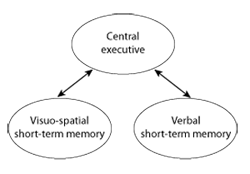
The verbal short-term memory store holds verbal information - words and sentences and numbers - for brief periods of time and is located in the left hemisphere of the brain. This component is sometimes referred to as the phonological loop as it typically holds information in a speech based form.
Visuo-spatial short-term memory store holds images, pictures and information about locations for brief periods of time and is located in the right hemisphere of the brain.
The capacity of each of these three components increases with age during childhood.
The capacity of each component can be measured.
Children with Down syndrome usually have better visuo-spatial than verbal short-term memory abilities.
The working memory system is important for spoken language learning and for reading and maths in the classroom as well as in attending to instructions and processing information throughout daily activities.
Useful references
- Gathercole SE, Alloway TA. Working memory and learning - A practical guide for teachers. Sage Publications; 2008.
- Pickering SJ, editor. Working memory and Education. Academic Press; 2006.
Alloway TP, Gathercole SE, editors. Working memory and neurodevelopmental disorders. Psychology Press; 2006.
- Buckley S, Bird G. Memory development in individuals with Down syndrome. Down Syndrome Education International: 2001. [Read Online]
Parents were trained to carry out the intervention programmes with their children. Parents were given training at the start of the study and supported by weekly telephone calls during the training periods. The verbal memory training was delivered entirely in an auditory/verbal mode - the children had to listen to digits spoken and then to say them, with the number of digits in the lists to be recalled increasing as children succeeded at a list length (e.g. 2 digits, then 3 digits, then 4 and 5 for some children). There were no visual materials used to support their learning as in some previous training studies [3,4] . This was an ambitious project as the tasks were really quite challenging but the aim was to really focus on trying to improve listening memory directly.
In order to be sure that any gain on the verbal training programme was specific to the training, an alternative intervention using visual activities was used for comparison. The children were put into 2 groups and one group began with verbal memory training, the other with visual activities. The training sessions for each intervention took place for 10 minutes, 5 times each week for 3 months. Progress was audio-taped and tapes plus score sheets mailed to the research team weekly. After 3 months, the groups changed to the other activity and after another 3 months went back to the first activity programme for a further 3 months.
Firstly, the results show that parents were able to implement the memory training at home and record progress. This is an important finding as the verbal memory training task was not easy for the children and they had to do it 5 times each week. The parents were supported on an ongoing basis but the study does demonstrate that parents can be actively involved in intervention research in this way. Secondly, the memory training did lead to a small but significant increase in digit span for the group - with some children making substantial progress and others less. There was also evidence that the use of phonological (speech based codes) in memory increased as a result of training and this could have important effects for improving the children's ability to learn the sound patterns of new words.
Working memory delays are also seen in children within the non-disabled population in regular classrooms, and Sue Gathercole and colleagues have carried out a number of studies with these children in recent years (see ref 5). They have also been investigating the effectiveness of memory training and report positive results of using computer training programmes with children with ADHD and with children with poor working memory (see ref 5). This team have used Robomemo, produced by CogMed [6] , and children work on this daily. The author and colleagues have had positive results in a small pilot study using the Mastering Memory software [7,8] with children with Down syndrome of primary school age.
Clearly there is a need for further research into memory training which evaluates different approaches to training and also follows up post-intervention to see if benefits of training last. In our previous work, we found an interaction between classroom settings, reading progress over time and lasting gains from memory training games. Specifically, the children in mainstream classrooms who were in daily reading instruction gained from memory training and continued to improve their short-term memory skills over time, while those in special education classrooms showed equally good gains at the end of the memory training period but these gains disappeared over the next 18 months [9] .
Further research into both home based and classroom based memory training could lead to gains in memory, speech and language and literacy for children with Down syndrome. The fact that progress in these areas is inter-related requires more training studies to take account of all these skills at the outset and following training studies should also take account of the educational settings and educational experiences of children taking part in training.
Sue Buckley is at Down Syndrome Education International, Portsmouth, Hampshire, UK. e-mail: sue.buckley@dseinternational.org
Published online: 30 September 2008
References
- Jarrold C, Baddeley AD. Short-term memory in Down syndrome: Applying the working memory model. Down Syndrome Research and Practice. 2001:7:17-21. [Read Online]
- Conners FA, Rosenquist CJ, Arnett L, Moore MS, Hume LE. Improving memory span in children with Down syndrome. Journal of Intellectual Disability Research. 2008; 52(3):244-255.
- Broadley I, MacDonald M. Teaching short-term memory skills to children with Down's syndrome. Down Syndrome Research and Practice. 1994;1:56-62. [Read Online]
- Comblain A. Working memory in Down's syndrome: training the rehearsal strategy. Down Syndrome Research and Practice. 1994;2:123-126. [Read Online]
- Gathercole SE. Working memory in the classroom. The Psychologist. 2008;21(5):382-385. (https://www.thepsychologist.org.uk/archive/) and see https://www.york.ac.uk/res/wml
- www.cogmed.com
- https://www.masteringmemory.co.uk/
- see page 16 in Buckley S, Bird G. Memory development in individuals with Down syndrome. Down Syndrome Education International; 2001.
- Laws G, Buckley SJ, Bird G, MacDonald J, Broadley I. (1995) The influence of reading instruction on language and memory development in children with Down syndrome. Down Syndrome Research and Practice. 1995;3(2):59-64. [Open Access Full Text]