







Full potential
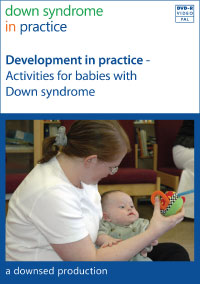
A review of Development in practice - Activities for babies with Down syndrome, a DVD video published by Down Syndrome Education International. The review was first published in Nursery World magazine.
Sillitoe, S. (2008) Full potential. Down Syndrome Research and Practice, 12(2), 128-129. doi:10.3104/resources.2061
Families and childcarers in charge of children with Down syndrome can now find essential information, advice and suggestions for activities, thanks to an educational charity.
Every year, approximately 600 babies in the UK are born with Down syndrome, making this one of the most common causes of learning disability. To assist these children, it is vital that parents, teachers, health and daycare practitioners understand the condition and recognise the types of activities that can best help them to achieve their potential.
Down syndrome does result in some delays in a child's development, but with appropriate education, therapy and social support, the majority of the 30,000 affected people in the UK can lead full and active lives.
One organisation that focuses on the education and development of people with Down syndrome is Down Syndrome Education International.
For the past 25 years the charity has undertaken research and provided information, training and advice to promote the development of people with Down syndrome. As well as offering early intervention services at The Sarah Duffen Centre for babies and pre-school children in Portsmouth, the charity also provides numerous publications and training courses for parents, teachers and practitioners who come into contact with these children.
Recently, the charity launched a 77-minute DVD entitled Development in Practice: Activities for babies with Down syndrome. This resource illustrates a wide variety of practical activities which can all be woven into everyday routines, whether the child is at home with parents or in a daycare setting.
Early intervention
Professor Sue Buckley, the charity's founder and a leading researcher in the education and development of children with Down syndrome, says the DVD represents the progression of a three-year project the charity undertook with the Government's Early Support Programme.
"We introduced the concept of a Developmental Journal for babies with Down syndrome to allow their development to be recorded," Professor Buckley explains. "Early intervention is vital, and naturally we want to promote better services from birth, which is why we are developing materials that look at best practice. We have already produced a number of publications on early development, but the DVD format allows us to offer advice in a highly captivating and easy to understand way."
She adds, "In time, we hope to stream the material on to our new website, which will make it even more accessible to the parents and professionals involved with these children."
Strengths and needs
The DVD contains information that is useful to parents in the first few months of their child's life - often a time when they are not receiving much professional support. It explains very clearly how, from birth to 18 months, babies with Down syndrome make progress in all areas of development, in the same way as other children, but usually at a slower pace.
Rosie Mangan, a teacher who works with babies and families as part of the portage service in Bromley, Kent, corroborates the importance of practitioners approaching each child individually.
"When we first visit a child with Down syndrome at home, we assess where the child is at developmentally and plan small but steady steps for learning," she says.
"These steps are based on developing language and cognitive skills and looking at any particular individual areas. Different families will have different concerns, and their input is vital."
Ms Mangan's service includes setting up early learning groups which give local parents and children opportunities to interact. "This can be the precursor to children going into nurseries or other settings and helps to develop social interaction," she says.
Further information
Development in Practice: Activities for babies with Down syndrome can be ordered at www.dseinternational.org for £15.90.
A full transcript of the voice-over of the film is available at www.dseinternational.org/practice/transcripts
Sue Buckley emphasises that research into Down syndrome clearly indicates the need for early intervention if children are to achieve their full potential.
"These babies have specific strengths and weaknesses. Their social and communication skills are well advanced, yet they do develop motor skills at a slower pace and need to be physically supported in ways that enable them to relax and explore their surroundings," she says. "They also need more time to respond to a stimulus because it takes them longer to process information. Helping these babies communicate and tune into language and talking is vital for their ongoing development and self-control."
Research shows that babies with Down syndrome benefit from a very settled routine. "They also need lots of security in the first year of life, and this has a significant impact on their ongoing behaviour and their ability to integrate into mainstream nurseries and schools," says Professor Buckley.
Nursery staff are among the target groups for Down Syndrome Education International's DVD, because many of the activities described in it can be easily applied to a daycare setting.
"We find that nursery staff who come into contact with babies with Down syndrome are generally happy to learn new ideas and ways in which they can help," Professor Buckley adds.
With the growing success of early intervention programmes, this DVD clearly will provide a valuable resource for early years practitioners.
Case study: a developmental journey to watch
As the mother of a young man with Down syndrome, Helen Norris is unequivocal about the benefits of Down Syndrome Education International's Development in Practice DVD.
"I only wish it had been available when my son was born," she says. "It would have made a world of difference."
Ms Norris is head of Pre-School Specialist Support Services for Bromley, Kent - a role which includes being head teacher of the multi-agency Phoenix pre-school assessment centre. She believes that the advice and tips given in the DVD have relevance for all practitioners working with children who have special needs, not just those with Down syndrome.
"What I really like about this DVD is that none of the babies' ages are given, so parents and daycare staff who see it watch a developmental journey, rather than being forced to compare how well their child is doing in relation to anyone else's," she says.
She believes the DVD is useful on many levels. For experienced staff, it serves as a reminder of the skills and strategies they need to use if they are to help babies with Down syndrome and special needs develop to their full potential. For less experienced staff and parents experiencing Down syndrome for the first time, the DVD contains plenty of good practical advice that will not only allow them to give their children the best start but will also help them feel less vulnerable.
"Parents who are new to Down syndrome often initially feel helpless that there is nothing they can do. This DVD clearly shows that the future isn't bleak and that there is plenty they can do from day one to help their child develop," she adds.
"We will certainly be using it as part of our staff training and we will be making it available to our Early Support and Portage teams so that they can get it to parents from the time of earliest referral of their child, along with the Early Support materials."
Sue Sillitoe writes for Nursery World. This review was first published in Nursery World on 9 August 2007 and is reproduced with the permission of the publisher.