Challenge Me! Mobility Activity Cards
The Challenge Me! Mobility Activity Cards address mobility, balance coordination, spatial awareness, trunk control, transferring skills, gross motor skills, flexibility, adaptability, safety awareness, and independence.
Hughes, J. (2007) Challenge Me! Mobility Activity Cards. Down Syndrome Research and Practice, 12(1), 43-43. doi:10.3104/resources.2023
I'm always on the look-out for useful, practical activities that can be worked into everyday games - and that is just what I found in these cards.
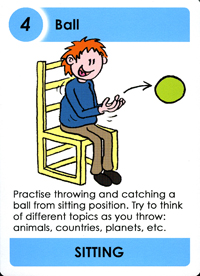
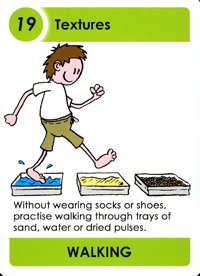
The Challenge Me! Mobility Activity Cards address mobility, balance coordination, spatial awareness, trunk control, transferring skills, gross motor skills, flexibility, adaptability, safety awareness, and independence. Practising these skills can also have a knock-on effect on self-esteem and confidence.
It's very important to read the instruction booklet that comes with the cards, as safety information and more detailed information about each exercise is found in the booklet. The introduction about how to use the cards gives clear instructions that are easy to follow. The cards are divided into seven types of challenges:
- sitting challenges
- standing challenges
- walking challenges
- floor ladder challenges
- stair challenges
- jumping challenges
- rolling challenges
There are also cards that provide 'extra challenges' for more advanced skills and there are free cards, so that children can choose their own challenges.
The guidance for working with the cards provides many useful ideas to help to maintain interest and motivation. There is also a list of useful equipment and resources. In reading all the cards, it was obvious that activities can be adapted to accommodate different types of equipment (e.g. not all homes/schools will have parallel bars, but parents/teachers can use other means to support a child physically). There is also a reminder about facilitation - making sure the child understands the task and expectations either through demonstration, verbal instructions, breaking things down, etc. Facilitation can also require you to look at the environment, the group dynamics, the equipment, and the motivators.
The booklet provides precise instructions for each card. Each activity has a level 1 and a level 2. Level 1 gives examples of how to break a task down and practice the steps. Level 2 gives ways of making the challenge more complex for those who are able to achieve level 1. The pictures on the card are very useful and make the instructions more clear and all the cards are colour coded, which helps in your organisation of activities.
Further information
Written by Amanda Elliott (2006)
Illustrated by David Kemp
Published by Jessica Kingsley Publishers, London
E-mail: post@kjp.com
Web: www.jkp.com
ISBN: 978 1 84310 497 1
Parents and professionals will get lots of ideas for games and activities that help promote mobility skills from these activity cards. They also highlighted for me that all your normal, everyday physical activities, such as sitting, standing, walking, moving between activities, etc., are exercise and practice for promoting the development of physical mobility.
There is a clear warning on the cards for activities that require extra caution, particularly for the sensitive head and neck areas. For activities that require forward and backward rolls and hand stands, I would suggest getting advice from an appropriate professional as children with Down syndrome may be at risk for atlanto-axial instability, or difficulties in the top part of the spinal column.
The Challenge Me! Mobility Activity Cards provide easy and fun ways to practice physical skills. They would be particularly good for parents to use at home and for children to use at lunch and play times at school. They could help facilitate social games as the activities are accessible at a variety of levels. The age-range stated on the cards is 3-12 years, however, this lower limit may need to be raised for some children with Down syndrome as they may not be ready to access the beginning activities until they are a bit older. The first activity requires the child to sit and be able to balance an egg (or ball) on a spoon. The activities get progressively harder from there.
Julie Hughes is at Down Syndrome Education International, Portsmouth, Hampshire, UK.