







An exploratory study to investigate different methods for teaching sight vocabulary to people with learning disabilities of different aetiologies
Two contrasting theories of learning were compared to ascertain the most effective method for teaching sight vocabulary to children and adults with learning disabilities of differing aetiologies (Down syndrome and non-specific learning disabilities). A control group of children, matched for mental age, was included for comparison. Samuels' (1967) focal attention theory suggests that, for beginning readers, when a new word to be learned is accompanied by other stimuli, such as a related picture, less efficient learning occurs. Goodman's (1965) theory, however, would refute this. His theory suggests that the presence of a related picture improves learning. Results of the present study reinforced Samuels' theory. Children of normal ability learned best when the target words were presented on their own (p<0.02). All other individuals (children and adults) followed this trend, however, results did not reach statistical significance when learning conditions were compared. The study suggests that sight vocabulary is learnt most efficiently by all participants using a similar strategy, that is, when the target word is presented alone. However, before firm conclusions can be drawn, it is recommended that further study is carried out relating to both children and adults with learning disabilities. Findings will have an impact upon teaching practice.
Hill, L. (1995) An exploratory study to investigate different methods for teaching sight vocabulary to people with learning disabilities of different aetiologies. Down Syndrome Research and Practice, 3(1), 23-28. doi:10.3104/reports.48
Introduction
Until recently, the education of people with learning disabilities was not regarded as a high priority. Society had produced such derogatory labels as 'idiots', 'feeble minded', 'morons' or 'imbeciles' to describe these individuals. However, thankfully, attitudes have begun to change. It has gradually been realised that these people do have the right to go to school or college to learn, just as their 'neighbours'.
The introduction of the Education Act (1981), a principle of which is that an integrated learning environment is preferable for all children regardless of ability, has opened the doors for children with special needs. It is essential, now, that up to date information is obtained so as to utilise the most effective teaching methods for each individual. Turnbull and Schultz (1979) comment,
"often the most critical educational disadvantages for handicapped students is that instructional strategies in education classes are not often tailored to their needs" (p. 48).
The present study was introduced to compare the learning strategies adopted by children of normal ability and two groups of children with special needs (Down syndrome and non-specific learning disabilities) when learning to read. This sought to clarify whether similar strategies were preferred. Adults with Down syndrome and non-specific learning disabilities were also assessed to ascertain whether these preferences change with age.
Literature in the area of learning sight vocabulary is extensive. Two major contrasting theories are evident; an intellectual battle has ensued with convincing recommendations from each interpretation. The two main instigators of the contrasting views are Samuels (1967) and Goodman (1965).
Samuels (1967) suggests that when a new word to be learned is accompanied by other stimuli, such as a related picture or sentence, less efficient learning and retention takes place. The reason put forward for this detrimental effect is that part of the person's attention is directed away from the new word and towards the accompanying cue, for example, a line drawing or coloured picture of the printed word. The focal attention theory contends that picture and context cues deter acquisition of reading responses because they enable the student to identify the word in practice without focusing on its graphic features (Singer, Samuels and Spiroff, 1973). Pictures, it was claimed therefore, distracted the learner from focusing attention on the printed words.
This theory acknowledges that pictures or associated sentences can prompt a correct response to printed words. The ensuing argument, however, states that this could be detrimental to the learning of new words. If the reader depends on the extra cues to anticipate the unknown word, then appropriate responses to the graphic features of the word may not be acquired. Thus if the word is subsequently tested in isolation then incorrect responses may occur (Singer, Samuels and Spiroff, 1973). Samuels ' (1967) theory rests on Underwood 's (1962) theory of cue selection in verbal learning. Underwood's principle states that,
"given a nominal stimulus which can be fractionated, the more meaningful component will become the functional stimulus" (cited in Samuels, 1977; p362).
Samuels (1967) explains that his study was based upon this principle of least effort in the area of word recognition. His argument for the focal attention theory in relation to the presence of pictures when learning new words states that with the presence of both the word and the picture, the student selects the picture as the cue since it is the more meaningful component. Subsequently, when the picture is removed, the student is unable to give the correct response.
Goodman (1965), in contrast, believes that adding a related picture to the word to be learnt enhances learning. He suggests that words which are presented in some meaningful context are learned more efficiently than words which are presented in isolation. He formulated a linguistic or contextual hypothesis based on his demonstration that contextual constraints facilitated identification of words which children could not recognise when the words were presented in isolation. Goodman suggests that integrating this method of teaching for learning new words improves reading ability because the syntactic and semantic constraints of the sentences provide cues for anticipating the unknown words. He believes that a confirming response from perceiving part or all of the word is all that is necessary for progression of reading to occur. If negative feedback is obtained then spontaneous correction will occur.
The contextual theorists argue that previous studies denying the benefits of using pictures actually made pictorial stimuli redundant because of their combined usage of verbal feedback. They proposed that this in itself provided all the extra word information needed so that the picture subsequently became superfluous. Denberg (1976-77) confidently points out the facilitative effect of pictures when learning to read. She states that,
"pictures are introduced, not to supplant print but to provide one additional source of information from which the beginner can sample as he reads. Increasing the amount of available information through the medium of pictures is shown to have a strong facilitative effect on word identification in context and a smaller, though significant, facilitative effect on word learning" (p176).
Other researchers have tested both theorists' findings. Singer, Samuels and Spiroff (1973) and Harzem, Lee and Miles (1976) are amongst the supporters of Samuels' theory of learning. Denberg (1976), and Montare, Elman and Cohen (1978), in contrast, support Goodman. Thus there is much controversy over the most appropriate method for teaching sight vocabulary.
Singh and Solman (1990) appear to be among the first investigators whose client group had learning disabilities. In their study students with Down syndrome and those with a non-specific learning disability were assessed as one group. Singh and Solman (1990) replicated Samuels' findings, but their reasons for this pattern of response are slightly different. They suggest that the previously learned association between the picture and the response may act to block the formation of a new association between the written word and the response thus causing difficulty in learning written words when they are paired with pictures. Buckley and Bird (1993) advocate the use of words printed neatly on flash cards by hand in lower case and without any pictures (p37) for obtaining most efficient learning. They suggest that experience, together with research on ordinary children, has led to their application of this method. The present study researches this 'experience' to examine their suggestion.
The present study investigates the efficiency of three different learning strategies for teaching sight vocabulary to people with learning disabilities of differing aetiologies (children and adults diagnosed as having Down syndrome and children and adults diagnosed as having a non-specific learning disability). Children of normal ability, matched for mental age, are also included for comparative purposes. The chosen learning strategies are based upon the two contrasting learning theories: the contextual theory (Goodman, 1965) and the focal attention theory (Samuels, 1967).
Overall, the study examined:
- the number of correct words obtained in each of the three learning conditions for each group of people assessed.
- whether there was a difference in the preferred method of learning within each group.
- whether the resulting learning patterns were similar between the groups.
Learning strategies adopted
- visual presentation, one at a time, of four typed words to be learnt (Samuels' theory).
- visual presentation, one at a time, of four typed words to be learnt, but this time accompanied by a black and white line drawing of the word above the typed word (Goodman's theory).
- visual presentation, one at a time, of four typed words to be learnt, but this time accompanied by a colour picture of the word above the typed word (Goodman's theory).
The third condition was introduced to the study in order to monitor whether adding colour to the drawings had an effect upon the extent of learning.
Methodology
Participants
A total of fifty individuals participated in the study; thirty children and twenty adults. The children with either Down syndrome or a non-specific learning disability were randomly selected from a special needs school; the children of normal ability were randomly selected from a mainstream primary school. All adults were selected from one of three day centres. Three centres were contacted overall due to some difficulty in obtaining sufficient numbers of adults who fitted the selection criteria (that is, non-reader whilst able to understand the task).
Tables 1 and 2 give a breakdown of the number, mean chronological age and range, mean age equivalent score (mental age) and range for each group of participants. The mental ages were calculated using the British Picture Vocabulary Scale (Dunn, Dunn, Whetton and Pintilie, 1982). This assessment was administered to each individual to check that the groups were matched at the outset in terms of ability. The child groups were administered the short form; the adult groups were given the long form. This difference in the type of form administered was because of the children's tendency to have shorter attention spans.
| Children (n=30) | Down syndrome | Non-specific learning disability | Normal ability |
|---|---|---|---|
| number of children | 10 | 10 | 10 |
| mean chronological age | 13yr 3mth | 13yr 3mth | 4yr 8mth |
| chronological age range | 10yr 1mth to 17yr 7mth | 8yr 8mth to 19yr 3mth | 4yr 0mth to 5yr 3mth |
| mean mental age | 4yr 2mth | 4yr 1mth | 4yr 10mth |
| mental age range | 2yr 6mth to 6yr 8mth | 2yr 6mth to 5yr 9mth | 3yr 7mth to 6yr 8mth |
| Adults (n=20) | Down syndrome | Non-specific learning disability |
|---|---|---|
| number of adults | 10 | 10 |
| mean chronological age | 31yr 8mth | 41yr 6mth |
| chronological age range | 20yr 3mth to 43yr 4mth | 27yr 4mth to 52yr 1mth |
| mean mental age | 3yr 7mth | 5yr 8mth |
| mental age range | 2yr 4mth to 5yr 11mth | 4yr 0mth to 7yr 1mth |
Materials
For teaching the sight vocabulary
Words / pictures selected
Twelve words were chosen for inclusion in the teaching material. These consisted of eleven three letter words and one four letter word: bus, pen, eye, cup, car, dog, sun, key, bed, peg, ball and hat. The words were chosen so that a suitable picture could be found as a match to the word. Pictures were created using the computer package Coreldraw. All cards were 8 cm by 6 cm and laminated in thick plastic.
Teaching material for the pre-test
- 12 cards with 1 coloured picture on each card.
- 12 cards with 1 typed word centred on each card.
Teaching material for the learning trials
- 12 cards with 1 typed word centred on each card.
- 12 cards with 1 black and white lined drawing on each card, and the corresponding typed word printed below the drawing.
- 12 cards with 1 coloured picture on each card, and the corresponding typed word printed below the picture.
Teaching material for the test trials
- 12 cards with 1 typed word centred on each card.
The material was adapted from a study undertaken by Solman, Singh and Kehoe (1992). The words used in the present study were simplified as it was thought that those used in the Solman et al (1992) study would be too difficult as a starting point for this group of non-readers.
For obtaining ability level
- British Picture Vocabulary Scale (Dunn, Dunn, Whetton and Pintilie, 1982) assessment for calculating mental age.
Procedure
Design
A repeated measures design was incorporated into the study. Three learning conditions were available where all individuals participated in all conditions to complement Solman, Singh and Kehoe 's (1992) study. In order to implement the 'same subjects' design with regards the three conditions tested, all the words to be taught were available in all the three learning conditions. For example, the word 'bus' was available as a typed word on its own, secondly, as a typed word together with a black and white line drawing of a bus, and lastly, as a typed word together with a coloured picture of a bus.
For each individual, 12 words were presented for learning; four words were presented in the 'typed word only' condition, another four words were presented in the 'typed word plus black and white line drawing' condition and another four words were presented in the 'typed word plus colour picture' condition. Each individual had different combinations of words relating to the three learning conditions to ensure that learning was not influenced by certain words being 'easier to learn' than others.
A single teaching session of between one and two hours was offered to each participant on an individual basis. A pre-test excluded those individuals who could recognise one or more of the words to be learnt before teaching began. The teaching procedure for the two groups of adults (see Figure 1) consisted of 10 alternate learning and test trials. During the learning trials, the 12 words (four from each learning condition) were shown individually for five seconds each and the participant was given the opportunity to say what the word said. Feedback was given as to whether the individual obtained the correct word. The word was then repeated by the researcher. During the test trials, however, (which consisted of just the 'word only' condition) no feedback was given.
This method of alternating the presentation of the learning and test trials was continued until all trials were completed. Once the teaching procedure was completed, to check that the groups were matched at the outset in terms of ability, the British Picture Vocabulary Scale (Dunn et al., 1982) was then administered. A similar teaching procedure was introduced for the groups of children, however, only six learning and test trials were administered as 10 of each proved to be too lengthy a procedure for the children's level of attention.
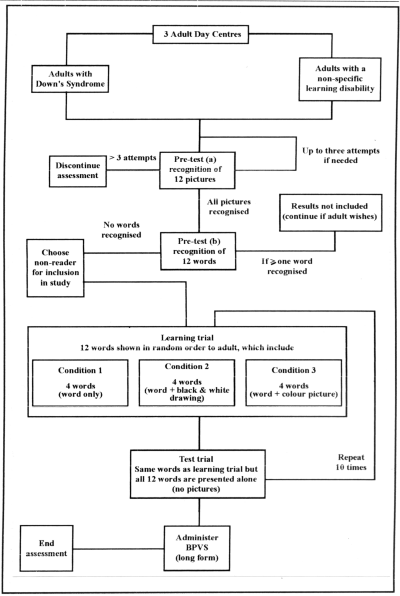
Figure 1. Adults. Flow chart to show the process undertaken during a typical teaching session.
Results
Child Data
British Picture Vocabulary Scale scores showed that all three groups of children were matched in terms of mental age when their scores were compared using a one-way analysis of variance test.
Tables 3 and 4 show, for learning and test trial scores respectively, the mean number of correct words obtained for each condition, for all three groups of children tested. The total number of new words presented for learning is 12. These words are repeated during each of the six trials, thus creating a maximum possible score of 72. However, as there are three conditions for each trial, the maximum number of correct words that can be obtained for each of these conditions over the six trials is 24.
| LEARNING TRIALS Type of Condition | Down syndrome | Non-specific learning disability | Control |
|---|---|---|---|
| word only | 2.4 | 1.0 | 7.1 |
| word & black & white line drawing | 23.2 | 24.0 | 24.0 |
| word & colour picture | 23.9 | 24.0 | 24.0 |
| significance level between conditions | p<0.001 | p<0.001 | p<0.001 |
One-way analysis of variance tests were undertaken separately for each group of children to see whether there were any significant differences between the three learning conditions. Table 3 shows the clear advantage that the presence of either a black and white line drawing or a colour picture has when the children are responding to the naming of a word.
| TEST TRIALS Type of Condition | Down syndrome | Non-specific learning disability | Control |
|---|---|---|---|
| word only | 3.5 | 2.1 | 8.4 |
| word & black & white line drawing | 1.5 | 1.1 | 4.3 |
| word & colour picture | 2.2 | 0.2 | 3.2 |
| significance level between conditions | ns | ns | p<0.02 |
From the mean scores obtained in Table 4, all three groups of children revealed most learning in the 'word only' condition. To see whether these differences were significant, one-way analysis of variance tests were undertaken for each group. Results showed that there were no significant differences in the number of correct words obtained between the three learning conditions for children with either Down syndrome or a non-specific learning disability. However, for the children of normal ability, significantly more correct words were obtained in the 'word only' learning condition. Page's L Trend Test was further carried out on this data to confirm that this was where the significance lay (p<0.05).
Adult data
When the two groups of adults were compared on the scores obtained from the British Picture Vocabulary Scale, those with a non-specific learning disability revealed significantly higher vocabulary scores (that is, a higher mental age) than the adults with Down syndrome when an unrelated t-test was applied. It was thought that comparison between the adult groups in relation to the different learning conditions in the reading task could not go ahead because of this difference. However, when the total number of correct words were compared regardless of the condition undertaken, there was no significant difference in learning between the two groups when an unrelated t-test was applied. Comparisons between the learning conditions therefore continued.
Tables 5 and 6 show, for learning and test trial scores respectively, the mean number of correct words obtained for each condition and for both groups tested. Once again, the total number of new words to be learnt is 12. These words are repeated during each of the 10 trials, thus creating a maximum possible score of 120. However, as there are three conditions for each trial, the maximum number of correct words that can be obtained for each of these conditions over the 10 trials is 40.
| LEARNING TRIALS Type of Condition | Down syndrome | Non-specific learning disability |
|---|---|---|
| word only | 8.9 | 10.1 |
| word & black & white line drawing | 36.6 | 39.4 |
| word & colour picture | 37.9 | 39.0 |
| significance level between conditions | p<0.000 | p<0.000 |
| TEST TRIALS Type of Condition | Down syndrome | Non-specific learning disability |
|---|---|---|
| word only | 8.8 | 10.2 |
| word & black & white line drawing | 6.1 | 7.2 |
| word & colour picture | 8.0 | 6.8 |
| significance level between conditions | ns | ns |
Mean scores show considerably less correct words obtained in the 'word only' condition during the learning trials. One-way analysis of variance tests applied to the three learning conditions, separately for each group of adults replicate the data obtained from the three groups of children; pictures or line drawings clearly help in obtaining a correct response.
The test trial data shows that, once again, the 'word only' condition revealed most learning for both adults with Down syndrome and adults with learning disabilities. However, one-way analysis of variance tests for each group did not show a significant advantage for one particular learning condition.
Present findings from the learning trials have been replicated many times (Goodman, 1965; Samuels, 1967; Samuels, 1970; Singer et al., 1973; Montare et al., 1978). Both the focal attention theorists and the contextual theorists agree that more words will be recognised during learning trials if a picture is available on the same card as the word. The picture acts as a guide to the individual with regards what the printed word says. The theorists' differences are made plain, however, in relation to responses obtained during test trials.
Results from the test trials of the present study showed that children of normal ability learned significantly more words when these words were presented in isolation. Samuels' focal attention theory is reinforced. Results for the children and adults with Down syndrome or non-specific learning disability revealed a trend in this direction when the mean number of correct words obtained are studied. However, when the learning conditions were compared using one-way analysis of variance tests for each group separately, no significant difference was found between the three conditions.
Discussion
Most first reading books, it seems, adhere to Goodman's theory of learning; brightly coloured pictures often accompany the words to be learnt. However, this clearly contrasts with Samuels' findings. As both theorists are committed to substantiating their claims, a number of research studies have been carried out in this area with the anticipation of reaching just one conclusion. The present study was undertaken with this 'anticipation' in mind.
Samuel 's (1967) focal attention theory appears to be preferable as a model for teaching non-readers of normal ability new words. The corresponding trend in this direction with regards all groups of participants diagnosed as having learning disabilities, again suggests that this teaching method should be implemented for most beneficial effect. However as these findings did not specifically show significantly more correct words in the 'word only' condition, it is recommended that further study is carried out in this area before firm conclusions are drawn.
Even so, tentative proposals can be made. It seems likely that all groups involved in the study gain from similar methods of teaching instruction. This would clearly be of benefit in a school environment that is dedicated to the integration of children of all abilities. Methods of teaching would not have to be altered to any great extent in order to meet the needs of these children; they would not have to feel that they were 'different'.
Statistical significance in favour of the 'word only' condition may not have occurred between the test trials for individuals with learning disabilities due to their characteristic lower level of learning development, particularly as only a short teaching session was offered. Further study in this area would benefit from a slight change of method. Individuals would probably learn more if, initially, fewer words were introduced for learning. It would, no doubt, also be more beneficial to extend the teaching period so as to introduce several sessions rather than implementing just one session that may serve to lose the individual's interest and attention. These changes could apply to both children and adults with learning disabilities.
Acknowledgements
Particular thanks to all Day Centre staff and attenders, school staff and pupils for enabling the study to take place and to Jane Green for collecting the child data.
References
- Buckley, S.J. & Bird, G. (1993). Teaching children with Down Syndrome to read. Down Syndrome: Research and Practice, 1(1) 34-39. [Read Online]
- Denburg, S.D. (1976-1977). The interaction of picture and print in reading instruction. Reading Research Quarterly, 12(2) 176-189.
- Dunn, L.M., Dunn, L.M., Whetton, C. & Pintilie, D. (1982). British Picture Vocabulary Scale. Windsor: NFER-NELSON.
- Education Act (1981). London: HMSO.
- Goodman, K.S. (1965). A linguistic study of cues and miscues in reading. Elementary English, 42, 639-643.
- Harzem, P., Lee, I. & Miles, T.R. (1976). The effects of pictures on learning to read. British Journal of Educational Psychology, 46, 318-322.
- Montare, A., Elman, E. & Cohen, J. (1978). Words and pictures: A test of Samuels' findings. Journal of Reading Behaviour, 9, 269-285.
- Samuels, S.J. (1967). Attentional processes in reading: the effects of pictures on the acquisition of reading responses. Journal of Educational Psychology, 58, 337-342.
- Samuels, S.J. (1970). Effects of pictures on learning to read, comprehension and attitudes. Review of Educational Research, 40(3) 397-407.
- Singer, H., Samuels, S.J. & Spiroff, J. (1973). The effects of pictures and contextual conditions on learning responses to printed words. Reading Research Quarterly, 9, 555-567.
- Singh, N.N. & Solman, R.T. (1990). A stimulus control analysis of the picture-word problem: the blocking effect. Journal of Applied Behaviour Analysis, 23, 525-532.
- Solman, R.T., Singh, N.N. & Kehoe, E.J. (1992). Pictures block the learning of sight words. Educational Psychology, 12(2) 143-153.
- Turnbull, A.P. & Schulz, J.B. (1979). Mainstreaming Handicapped Students: A Guide for the Classroom Teacher. Boston: Allyn and Bacon Inc.
- Underwood, B.J., Ham, M. & Ekstrand, B. (1962). Cue selection in paired-associate learning. Journal of Experimental Psychology, 64, 405-409. Cited in Samuels, S.J. (1977). Can pictures distract students from the printed word: a rebuttal. Journal of Reading Behaviour, 9, 361-364.