







Early communication and cognition in children with Down syndrome
The relationship between cognitive abilities and communication continues to be a topic of interest and argument. These theoretical debates in psychology and linguistics have a relevance to the way we plan intervention. A modular view of language suggests that intervention should be focussed on language itself. Cognitive views suggest that intervention should be more broadly based. In our research we have examined predictions from cognitive theories which suppose that there are particular relations between communications and cognition. The research concerned a small group of children with Down's syndrome who were visited every four weeks over a period of six months. Our findings provide some limited support for one of the cognitive theories; this implies a linking of communication and cognition during certain periods of development. Another notable feature of our findings was the delay in language production, relative to other abilities in children with Down's syndrome.
Messer, D, and Hassan, P. (1994) Early communication and cognition in children with Down syndrome. Down Syndrome Research and Practice, 2(1), 3-10. doi:10.3104/reports.24
Introduction
The focus of our research has been on the relationship between communication and other cognitive abilities in children with Down syndrome. The aim has been to gain a better understanding of the early stages of language acquisition with these children. There is still considerable discussion about the way that language is acquired and these theoretical discussions do have a bearing on the approach that should be taken in designing language intervention programmes.
In recent years the old nature-nurture debate about language acquisition has changed and taken a new form. An influential and current form of the nature position regards the human ability to use language as attributable to specialised operations which are largely independent of other cognitive processes. Thus, for instance, Fodor (1983) proposes the existence of specific modules which are dedicated to dealing with particular types of information. Fodor argues that the following characteristics are typical of the way that modules process information, the operations are not accessible to consciousness, are automatic in nature, difficult to interfere with, and that they deal with a particular form of information.
These views of a dedicated innate module for language have also been accompanied by new theories about the way that language is acquired. Chomsky's language acquisition device has been superseded by government and binding theory or principles and parameters theory (the terms are interchangeable). One aspect of this theory is that language acquisition is possible because of the process of parameter setting. A parameter is considered to be a dimension of grammar which differs across languages. For instance, it has been suggested that one basic parameter concerns whether languages are left or right branching. In a right branching language, like English, extra material is usually added to the end of the utterance (e.g. Adam said that John believed that Fred can.......). In Japanese, a left branching language, extra material is added to the beginning of the utterance. Obviously there are many dimensions on which languages can differ, and it is possible for any parameter to have a number of forms across different languages.
In the parameter setting account it is supposed that humans have a knowledge base in the form of universal grammar which contains information about all the parameters which are used across the languages of the world. Thus, according to this account, children usually have the capacity to acquire any human language. Furthermore, according to this account, parameters can be set by children simply hearing examples of the parameter. In this way, a parameter is set by children hearing the speech of others. The parameter setting theory is still in a rudimentary form with many details still not worked out, even where more precise claims have been made there are disagreements between theorists about the exact mechanism of operation (see Weissenborn et al. 1992; Messer, 1994).
The adoption of this theoretical approach has been accompanied by suggesting that the causes of specific language impairment might be attributed to the failure of particular parameters to operate and this leads to the difficulties in speech (Rice & Wexler, 1993; Van der Lely, in press). If we extrapolate from this claim it might be supposed that children with Down syndrome, who often make poor progress in language acquisition, may have a number of fundamental problems with the whole parameter setting process. Another extrapolation from this theoretical approach is that to assist the development of language it is necessary to concentrate on purely linguistic processes, because if language involves an autonomous module it follows that one would not expect language development to be aided by the development of other cognitive skills.
A very different perspective has come from those who believe that language and cognition are related at particular points in development. In the past it has been suggested that cognition and language are closely and continuously connected, this can be seen in the writings of Werner and Kaplan (1963), and in the work of Piaget (1962); they treated language as just one manifestation of general cognitive development. These strong versions of the cognitive hypothesis are no longer generally accepted. In their place has been suggestions about specific rather than general links between cognition and language (Bates, O'Connell & Shore, 1987; Gopnik & Meltzoff, 1986). According to these perspectives there are particular points in development where there are advances in the processing of information which bring about changes in both language and cognition. Within this theoretical orientation there are differences in emphasis.
In the specificity hypothesis of Gopnik and Meltzoff it is claimed that there are links between cognition and language which involve very similar sets of operations (Gopnik & Meltzoff, 1986; 1987). For example, it is supposed that advances in the understanding of object permanence is linked to children starting to use words to describe the disappearance of objects.
The local homology model of Bates and her colleagues takes a slightly different perspective by suggesting that general advances in the ability to process information bring about changes in a variety of domains of cognition, one of which involves communication and language. For example, it is supposed that the many changes in abilities at a mental age of about 18 months are due to children being able to process several rather than one item of information. As a result, children start to use two word utterances and show gains in memory tasks.
If language and cognition are related in the ways described by either of these hypotheses then this has implications for the process of intervention. It would be expected that language acquisition could be assisted by interventions which are directed towards both cognition and language. If these are carried out then it would be expected that specific language and cognitive developments would follow from this more general advance.
In the next two sections we will review two sets of analyses which have investigated the predictions of the specificity hypothesis and the local homology model in children with Down syndrome. In each section a fuller description of the predictions of the particular theory is provided together with details about the relevant methods and findings. First the common methods to this longitudinal study are outlined.
Methodology
Subjects
Our sample consisted of 10 children with Down syndrome. The children were diagnosed as having Trisomy 21. They were all living at home with middle class families who were members of the local Down Syndrome Association Support Group. None of the children was reported to have any serious health or hearing problems. The children were identified as being at three levels of communicative competence at the start of the study:
(i) a just-verbal group of 4 children, all female, whose single word vocabulary was either non-existent or minimal, their chronological age ranged from 16 to 30 months.
(ii) a verbal group of 4 children, all male who were producing single word utterances, their chronological age ranged from 3 to 4 years.
(iii) two female children who produced the occasional two word utterance whose chronological ages were both 42 months.
Overview of Data Collection
The children were seen monthly in their homes by the second author for a period of 6 months. The children were given a range of tasks with the sessions being video recorded. Further details about the tasks are given in the next two sections.
Information about the children's speech was collected by using the MacArthur Communicative Development Inventory (CDI; Fenson and Dale, 1990). This is a standardised checklist for the parents to identify the words that their child can comprehend and/or produce. The instrument has been shown to be reliable and valid (Dale et al. 1989). Half the items reported by the parents were tested and no discrepancies were found between parental report and our observations. As most of the families were using Makaton signs these were included in the CDI as a separate entry by the parents.
The Specificity Hypothesis
Piaget's work has provided a starting point for Gopnik and Meltzoff's model. Piaget supposed that at about 18 months children are able to form symbolic representations and as a result there are related cognitive developments involving vocabulary expansion, symbolic play and deferred limitation, all of which require the representation of an entity in a more abstract way. However, Gopnik and Meltzoff (1986) have reasoned that children achieve the ability to form symbolic representations before 18 months; before this age they are already using words and are able to imitate actions after having seen them. This has led Gopnik and Meltzoff to propose that underlying the changes at 18 months is the ability to construct hypothetical representations about things that have never been experienced. For example, they suppose that the ability to form hypothetical representations allows children on object permanence tasks not only to understand that an object continues to exist, but to develop hypotheses about where it is located.
Meltzoff and Gopnik (1989) have provided details of three sets of specific relations between cognition and speech. One involves a link between the use of cognitive relational words about disappearance (e.g. "all-gone") and the ability to pass object-permanence tasks which require children to understand that an object can be positioned in several locations. A second and similar link is between cognitive relational words which signal an understanding of success or failure in relation to an event (e.g. "oh dear" or "good") and the ability to pass means-ends tasks where children have to work out which strategy will be successful. Gopnik and Meltzoff (1986) believe both these abilities require children to be able to think about and evaluate hypothetical outcomes. The third link is between the ability to sort objects into groups and the vocabulary burst as this rapid expansion of vocabulary is believed to be based on children's ability to categorise (Gopnik & Meltzoff, 1987). Gopnik and Meltzoff have presented a number of studies of non-delayed children which indicate that these changes occur at about the same age. In order to discover more about cognition and communication and to test the specificity hypothesis we examined the development of these skills in children with Down syndrome.
Methods
Six of the children in the study were examined in relation to the predictions of Gopnik and Meltzoff, 4 children were excluded because they were not yet at an appropriate level of functioning or had progressed beyond this level. The children were only treated as having acquired a word or gesture for disappearance or success/failure if they had spontaneously used the word on at least 3 occasions in appropriate contexts. The children were then credited with being able to use the word on its first appearance.
The children were given 3 sets of tasks to assess their cognitive abilities in relation to Gopnik and Meltzoff's predictions. The object permanence and means-end tasks were the same adaptations of the Uzgiris and Hunt scales (Uzgiris and Hunt, 1975) as those used by Gopnik and Meltzoff (1984; 1986). These items are given in Table 1. Once a child had achieved success on a task, he or she was only considered to have acquired this skill at this session if he/she was also successful on the next two visits. In practice children seldom failed to reach this criterion.
| TASK DESCRIPTION | ||
|---|---|---|
| OBJECT PERMANENCE TASKS | 13 | Locating an object after it has been hidden under one of three covers. The child sees an object put under a small container. |
| 14 | Finding an object after a series of invisible displacements. An object is hidden in the experimenter's hand; | |
| MEANS-ENDS TASKS: | 9 | Using a string to retrieve an object that is out of view. |
| 10 | Using a stick to obtain an object that is out a reach. | |
| 11 | Placing a necklace in a bottle. | |
| 12 | Stacking a set of rings on a post, without using a "trick" ring which had no hole for stacking it. |
The other assessment involved sorting abilities which involved 6 sets of objects. Each set consisted of 8 objects to be sorted into 2 groups of 4. Some of these groups of objects differed in only one dimension (e.g. size), whereas others differed in more than one dimension (e.g. shape, colour, texture, etc.). This maximised the likelihood that children's competence would be accurately assessed, as objects which differ in more than one dimension are reported to be easier to group than those which differ on only one dimension (Riccuiti, 1965; Starkey, 1981; Sugarman, 1983).
The objects for the 6 tasks were: (i) toy cups and square blocks, (ii) large and small yellow foam cylinders, (iii) Fisher Price play people and racing cars, (iv) large and small red plastic spoons, (v) toy animals and toy cars, and (vi) multicoloured plastic plates and pink plastic plates. Each task began with 2-3 minutes of unstructured play, and any attempt to group the objects was recorded. If no attempt was made a prompt was given. This involved placing an example of each class approximately 3-4 cm. apart and within easy reach of the child who was handed the remaining objects in a mixed order. The child was asked "where does this go?" when each object was handed to them. The highest level of categorisation involved the child spontaneously forming 3 or 4 objects into a separate group from the other objects over 3 consecutive trials (Starkey, 1981)
Results
Overall the composition of the children's vocabularies was similar in content, although smaller in size, to that described by Gopnik and Meltzoff (1986). How was their speech related to their cognitive abilities?
Means-ends abilities and communication about success/failure
There is some ambiguity about the precise links predicted between the specific Uzgiris-Hunt tasks and speech in Gopnik and Meltzoff's publications. In an early paper on this topic Gopnik and Meltzoff (1986) suppose that children who cannot complete item 9 of the means-end tasks cannot use hypothetical representations to gain an insight into solving this type of task, and from this we can infer that they should not be producing success/failure words. Further, they claim that passing item 9 means the children are more likely to have this insight, and that passing any higher items are very likely to have this ability. In later work their predictions are clearer and they suppose that "words for success and failure appear in conjunction with the ability to use insight to solve means-ends tasks 10-12 (Gopnik and Meltzoff 1984, 1986)" (from Gopnik, 1988, p64). It is this later view which we evaluate here.
Figure 1 shows that at the beginning of the study four children were passing means end task 9. These children, according to the specificity hypothesis, were not expected to be producing success/failure words.
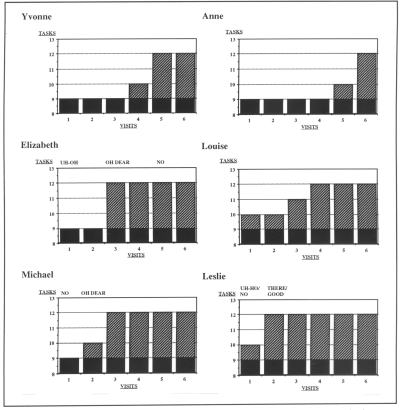
Figure 1. The relationship between communication about success/failure and performance on means end tasks.
The prediction was accurate for two of the children (Yvonne and Anne). One would also expect from the hypothesis that these two children would start producing success/failure words when they were successful on the more difficult means-ends tasks. However, although the children accomplished the higher level cognitive tasks they were never recorded as producing success/failure words.
In contrast, two other children (Elizabeth and Michael) were unexpectedly producing success/failure words when they were still only achieving a pass on task 9, and in the case of Elizabeth this was occurring 2 months before she passed a higher level task. Thus, in these two children, success/failure words were occurring earlier than would be expected on the basis of their cognitive abilities.
The two remaining children (Louise and Leslie) were already passing task 10 and so should have been producing success/failure words; this was true for Leslie, but Louise was never recorded as producing any such words. Thus, the predictions of the specificity hypothesis were not confirmed in this sample, in three cases although the appropriate level of cognitive ability was achieved, these words were never produced; in addition, in two cases children produced success/failure words when they had only passed task 9.
Object permanence abilities and communication about disappearance
Gopnik and Meltzoff (1986) state that children who can pass object permanence task 13 may have developed the complete object concept, from this it might be inferred that some would be able to produce words about disappearance. In this publication it is also observed that success on task 14 is highly likely to indicate the ability to use hypotheses in the service of solving object permanence tasks. However, in a later paper Gopnik (1988) writes that "there is evidence that disappearance words appear in conjunction with the ability to solve object permanence task 14" (p64). A similar claim is made in Meltzoff and Gopnik (1989).
Five children were only passing task 13 at the beginning of the study and therefore would not be expected, according to the specificity hypothesis, to be producing words about disappearance (see Figure 2). For three of these five children this was true (Yvonne, Anne and Louise), and even though these children later progressed beyond this level they were not recorded as producing any disappearance words.
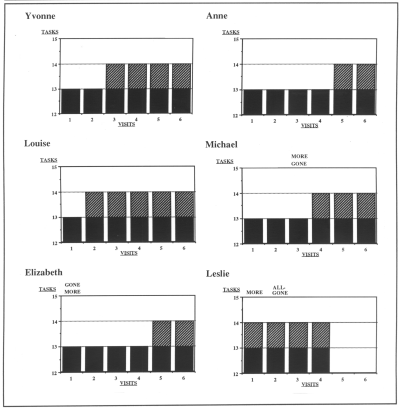
Figure 2. The relationship between communication about object existence and performance on object permanence tasks.
However, two of these five children who were only passing task 13 (Michael and Elizabeth) produced examples of disappearance words before being successful at task 14. In the case of Elizabeth this was accomplished 4 months before being successful on the higher level task. The sixth child (Leslie), at the beginning of the study was already passing item 14 and producing disappearance words, and therefore data about him cannot be used to test the specificity hypothesis. Thus, our findings revealed that one child produced disappearance words much earlier than would have been predicted by Gopnik and Meltzoff, and three children reached the appropriate cognitive level but failed to produce any words about disappearance.
Categorisation abilities and the vocabulary burst
A further prediction of Gopnik and Meltzoff (1987) is that the highest level of categorisation ability involving the spontaneous sorting of objects is related to the vocabulary burst. They define a vocabulary burst as the acquisition of more than 10 words in a month, although various other definitions have been put forward (e.g. Bates et al. 1987). In our sample only two children fulfilled this criterion in relation to having a vocabulary burst. In the case of Elizabeth, her vocabulary expanded from 20 to 31 words between visits 4 and 5; and she did not achieve the highest level on either of these two session (no further assessments were carried out). In the other case, Michael, he increased his vocabulary from 24 to 39 words between visits 2 and 3; at visit 2 he also achieved the highest level of categorisation, which gives the correspondence predicted in the specificity hypothesis. One other child achieved the highest level of categorisation, but her vocabulary remained at around 30 (Louise). Thus, only one of these three children fitted the pattern that was expected to occur.
Discussion of the Specificity Hypothesis
Our investigations revealed that a few of the children produced cognitive-relational words several months before they had mastered the appropriate sensory motor tasks. Nor did we find convincing evidence of a vocabulary burst accompanying the ability to sort objects into groups.
Our difficulty has been in knowing precisely how to interpret these findings. The most negative interpretation for the specificity hypothesis is that our findings indicate that the specified relations between cognition and speech are not invariant, and that the correlations observed in non-delayed children are purely fortuitous. Alternatively, our findings could be interpreted as indicating that development in children with Down syndrome is different from that in other children so that the same associations across cognitive domains do not occur. Thus, our findings raise questions about the cognitive changes identified in the specificity hypothesis, and suggest that its application may be limited, at the very least, to non-delayed children.
The Local Homology Model
The local homology model unlike the specificity hypothesis claims that general changes in cognitive functioning, at particular points in development, will affect a range of capacities and this includes communicative abilities. One prediction of the local homology model is that the transition from one to two word speech is the result of a general advance which enables children to process two items rather than one item of information (Bates et al. 1987). Following the work of Case (1985), Bates et al. suppose that this change occurs because children become more efficient at processing information, rather than there is an increase in memory capacity. In non-delayed children there are a number of changes which accompany the beginning of two word speech. These include the use of symbolic play, the ability to sort objects into two groups, and the ability to use two relations when copying a brick model.
The development of symbolic play in children with Down syndrome appears to follow a similar course to that in non-delayed children and there appears to be a similar pattern of links between developments in sensorimotor functioning and symbolic play. For example, the findings of Hill and McCune-Nicolich (1981), Beeghly et al. (1990) and Ogura et al. (1990) can be summarised as follows, prelinguistic children with Down syndrome do not engage in symbolic play, children who produce one word utterances only produce single symbolic schemes during play, and children who combine words are also able to combine symbolic schemes. These findings broadly support the local homology model.
Because previous investigations had already examined the links between symbolic play and speech we decided to investigate other ways of examining the links between cognitive functioning and the beginnings of two word speech. To accomplish this we examined the chronological relationship between the use of two word utterances and three abilities. These involved the ability to construct a "train" where one of two relationships had to be remembered, the ability to remember where two toys were located in a line of 10 small boxes, and the ability to sort objects into two groups.
Methods
The complete sample of 10 children were included in this analysis. The following gives an outline of the three tasks
Block Building
This involved the experimenter making a structure, knocking it down and then asking the child to build it. For the "train" task the criterion of "twoness" was achieved if the child was able to imitate a structure where one block was put on top of the other to make the "engine" of the train. Case (1985) and Bates et al. (1987) suggests that this involves the ability to remember two relationships.
Hiding Task
Toys were hidden in a rectangular wooden box which had 10 compartments. The door of each compartment was painted with a different colour. The children were asked to watch as the experimenter hid one toy in a compartment. The child was then asked to find where the named toy had gone. Once a child had successfully retrieved a single toy over 3 trials without any errors the same task was carried out with two different toys. To reach the criterion the same level of success over 3 trials without errors was required with the two toys.
The Sorting Task
It has been predicted by Bates et al. (1987) that if children can successfully separate two groups of toys then they show evidence of being able to deal with two items of information. The criterion we used was the highest level of sorting ability, when children can separate 3 or 4 objects from the others.
Results
Table 2 gives the visit on which children produced two word speech and achieved the criterion for "twoness" on the three tasks. The children are grouped according to their initial communicative abilities.
| Two words | Blocks | Groups | Hiding | ||
|---|---|---|---|---|---|
| Just Verbal Group | Yvonne | - | |||
| Anne | - | ||||
| Elizabeth | 5*6 | 5 | 6 | - | |
| Louise | 4*6 | 4 | 5 | 5 | |
| One Word Group | Michael | - | 1 | 4 | - |
| Harry | 6* | 2 | 1 | - | |
| Keith | 4* | 1 | 1 | 2 | |
| Leslie | 3* | 1 | 1 | 1 | |
| Two Word Group | Elaine | 1 | 1 | 3 | 2 |
| Anna | 1 | 4 | 1 | 2 | |
| * First two word utterance? Formulas - No consistent use ELIZABETH: Hello Daddy? 6*: Here you are. There you are. Here I am. LOUISE: Hello Dad Up 6* Put it back. HARRY: Here you are. Two words: Evidence of continued use and other 2 word utterances added subsequently. LESLIE: Apple juice: In there: Lid off: Mummy drink. (3) Where wall? KEITH Hello Mummy/Daddy: Mummy turtle: Mummy look. (4) More juice. | |||||
Two of the just-verbal children reached criterion on the 3 cognitive tasks towards the end of the study, and there is reasonable consistency in the visit when this was achieved. These children also produced two word utterances at about the same time as they passed the criteria for the cognitive tasks. However, their multi-word utterances appeared to be formulaic in character. The words in the utterances were not combined with other words and the particular examples were dropped from use after a period of time, with no other examples of multi-word utterances taking their place. Thus, for the just-verbal children the production of non-formulaic two word utterances did not accompany the cognitive advances as had been predicted by the local homology model.
In the group who were producing one word utterances at the beginning of the study, all four children were achieving the criteria set for the cognitive tasks on their first visit. However, two of the four children were not producing two word utterances until 2 or 3 months later, and the other two children did have convincing examples of flexible two word utterances at any point in the study (i.e. up to 6 months later). Thus, it would appear that the criteria for "twoness" on the cognitive tasks was in place at the beginning of the study, but two word speech appears to lag behind these advances.
The two children who were already producing two word utterances at the beginning of the study were, as predicted, also able to pass the criterion on the three tasks.
Discussion of the Local Homology Model
The findings did not support the prediction that two word speech would occur at the same age as the other cognitive changes. However, these findings are not as damaging to the local homology model as would first appear. First, most children passed all three cognitive tasks on the same visit, this suggests at least with the cognitive tasks that there may be some general change at about the same age. This finding is all the more remarkable as when the tasks were chosen it was not entirely clear to us what skills would give an accurate assessment of being able to deal with two items of information. Second, the delay between the cognitive advances and the production of two word speech was not entirely unexpected as it is becoming increasingly recognised that the production of speech in children with Down syndrome is delayed relative to their other abilities (Miller, 1988; Hasan and Messer, 1990). Third, Bates has suggested that when there are developmental delays that "comprehension has custody of cognition", meaning that changes in cognition will be associated with the ability to comprehend rather than the ability to produce speech.
Discussion
Discussion of the two sets of findings
The first set of analyses about the specificity hypothesis did not reveal a close correspondence between cognitive and communicative abilities. A few children used cognitive relational words before they reached the appropriate level of abilities. Such a finding, given the delays in speech production in children with Down syndrome are particularly puzzling. In addition, a number of the children appeared capable of using hypothetical representations in the Uzgiris-Hunt tasks, but did not produce cognitive relational words. Such findings, suggest at least for children with Down syndrome there may not be a close relation between these specific cognitive abilities and the use of speech
The second set of analyses provided evidence of general cognitive changes in the ability to process two items of information as predicted by the local homology model, but the use of non-formulaic two word utterances appeared somewhat later than this advance. These findings suggest that the invariant linking of cognitive changes with developments in communication does not always occur. However, Bates has admitted that sometimes these links will not be present in children with delays in their language. Furthermore, given the delays in the production of speech in children with Down syndrome it is reasonable to suppose that some more peripheral mechanism is responsible for the lack of two word utterances.
What implications do these findings have for intervention and practice? The first point to make is of course that the findings are based on a small sample so that we must be very cautious about drawing general conclusions from our findings. Because we found little support for the specificity hypothesis, the apparent absence of links between cognition and communication lend weight to the idea of speech being an independent module of functioning. Interestingly, at this level of communication many linguists would question whether children are using linguistic skills to organise utterances which have a grammatical structure (e.g. Radford, 1990), and whether there is the operation of linguistic modules.
The evidence for the local homology model is stronger. However, we found that productive speech was delayed relative to the children's other cognitive abilities. More information is needed about this relationship before we can know whether it is appropriate to recommend that children with Down syndrome should be helped to develop both cognitive and communicative abilities to assist their language. In relation to this, a point worth making is that if we take a wider picture, it is sensible to argue that concentrating solely on linguistic skills may be inappropriate, it is important to assist the development of the whole child. The attention paid to communication is a natural consequence of the importance of this to children's development, but this does not mean that other aspects of development should be neglected. Another feature of our findings is that they highlight the delay in the productive speech abilities of children with Down syndrome. This may provide one of the most important clues about the language problems that children with Down syndrome often encounter, and presents us with a formidable challenge to understand the basis for this delay.
Acknowledgement
The authors wish to thank the children with Down syndrome and their parents who took part in the research.
References
- Bates, E., O'Connell, B. and Shore, C (1987). Language and communication in infancy. In J. D. Ofosky (Ed.) Handbook of Infant Development. New York: Wiley.
- Beeghly, M., Weiss-Perry, B. and Cicchetti, D. (1990). Beyond sensorimotor functionism. In D. Cicchetti and M. Beeghly (Eds). Children with Down Syndrome. Cambridge: Cambridge University Press.
- Case, R. (1985) Intellectual Development: From Birth to Adulthood. New York: Academic Press.
- Dale, P., Bates, E., Reznick, S. and Morisset, C. (1989) The validity of a parent report instrument of child language at 20 months. Journal of Child Language, 16, 239 - 250.
- Fenson, L and Dale, P.S. (1990) Technical manual for the McArthur Communicative Development Inventories. Developmental Psychology Laboratory, San Diego State University.
- Fodor, J.D. (1983) Modularity in Language. Cambridge MA: MIT Press.
- Gopnik, A. (1988) Three types of early word: the emergence of social words, names and cognitive relational words in the one-word stage and their relation to cognitive development. First Language, 8, 49-70.
- Gopnik, A and Meltzoff, A.N. (1984) Semantic and cognitive development in 15-21-month-old children. Journal of Child Language, 11, 495-513.
- Gopnik, A. and Meltzoff, A.N. (1985) Words, plans, things and locations: Interactions between semantic and cognitive development in the one word stage. In S. Kuczaj and M. Barrett (Eds) The Development of Word Meaning. New York: Springer-Verlag.
- Gopnik, A. and Meltzoff, A.N. (1986) Relations between semantic and cognitive development in the one word stage - the specificity hypothesis. Child Development, 57, 1040-1053.
- Gopnik, A. and Meltzoff, A.N. (1987) The development of categorisation in the second year and its relationship to other cognitive and linguistic developments. Child Development, 58, 1523-1531.
- Hasan, P. and Messer, D.J. (1990) Communication and cognition in children with Down's syndrome. Paper presented at the IV European Developmental Psychology Conference. University of Stirling, UK.
- Hill, P.M. and McCune-Nicholich, L. (1981) Pretend play and patterns of cognition in Down's syndrome children. Child Development, 52, 1168-1175.
- Huttenlocher, J. and Smiley, P. (1987) Early word meanings: The case of object names. Cognitive Psychology, 19, 63-89
- Meltzoff, A.N. and Gopnik, A. (1989). On linking verbal imitation, representation, and language learning in the first two years of life. In G. E. Speidel and K. E. Nelson (Eds.) The Many Faces of Imitation in Language Learning. Springer-Verlag.
- Messer, D.J. (1994) The Development of Communication. Chichester: Wiley.
- Miller, J.F. (1988) The developmental asynchrony of language development in children with Down syndrome. In L. Nadel (Ed.) The Psychobiology of Down syndrome. Cambridge MA: MIT Press.
- Ogura, T., Notari, A. and Fewell, R. (1990) The relationship between language and play in Down's syndrome children . Presented at the 22nd International Congress of Applied Psychology, Kyoto, Japan.
- Piaget, J. (1962) Play, Dreams, and Imitation in Childhood. New York: Norton.
- Radford, A. (1990) Syntactic Theory and the Acquisition of English Syntax. Oxford : Blackwell
- Rice, M and Wexler, K. (1993) Types of agreement in SLI children. Paper presented at VIth International Congress for the Study of Child Language, Trieste.
- Riccuiti, H. (1965) Object grouping and selective ordering behaviour in infants 12 to 24 months old. Merrill - Palmer Quarterly, 11, 129-148.
- Starkey, D. (1981). The origins of concept formation: Object sorting and object preference in early infancy. Child Development, 52, 489-497.
- Sugarman, S. (1983) Children's Early Thought: Development in Classification. Cambridge: Cambridge University Press.
- Uzgiris, I.C. and Hunt, J.M. (1975) Toward Ordinal Scales of Psychological Development in Infancy. University of Illinois, Shampaign, Illinois.
- Van der Lely, H.K.J. (in press) Canonical linking rules: Forward vs reverse linking in normally developing and specifically language impaired children. Cognition.
- Werner, H. and Kaplan, B. (1963) Symbol Formation: An Organismic- Developmental Approach to Language and the Expression of Thought. New York: Wiley.
- Weissenborn, J., Goodluck, H. and Roeper, T. (1992) Introduction: Old and new problems in the study of language acquisition. In J. Weissenborn, H. Goodluck and T. Roeper (Eds), Theoretical Issues in Language Acquisition. Hillsdale, NJ: Erlbaum.