







The significance of maternal speech styles for children with Down syndrome
The aim of this study was to investigate whether mothers of children with Down syndrome are finding it difficult to provide their children with communicative experiences that might help promote linguistic progress beyond simple grammar, as a consequence of the children's own speech production difficulties. Nine children with Down syndrome were matched with nine typically developing children on level of receptive grammar. Video recordings of mothers engaging their children in ten minute conversations,in their own homes, were analysed. Mothers of children with Down syndrome made significantly more repetitions and expansions of their children's utterances than mothers of typically developing children did. Significant differences were not found in the amount of wh-questions, yes/no questions, tag questions, or two choice questions asked by mothers. Analysis of children's speech showed that children with Down syndrome had significantly shorter MLUs than the typically developing children. A greater percentage of children's longer utterances occurred when the preceding maternal utterance was a wh-question compared to a closed question. Almost three-quarters of closed questions received no verbal response or a single word answer from the child. Alternative strategies for managing conversations are discussed with the aim of extending the linguistic ability of children with Down syndrome.
Byrne, A, and Buckley, S. (1993) The significance of maternal speech styles for children with Down syndrome. Down Syndrome Research and Practice, 1(3), 107-117. doi:10.3104/reports.21
Introduction
Language Development in Children with Down Syndrome
Children with Down syndrome usually have great difficulty acquiring and using spoken language. The emergence of verbal ability is delayed (Cunningham, 1982) and continuing grammatical and pronunciation difficulties often make the speech of teenagers and adults difficult to understand (Buckley and Sacks, 1986). A detailed review of the literature on the development of speech, language and communication skills in the Down syndrome population (Miller, 1987) revealed no single pattern or profile of language development that describes all children with Down syndrome. Miller concludes that language skills are increasingly deviant relative to other cognitive skills with increasing chronological age in this population. The younger children up to about three years to four years of age exhibit similar syntax, semantic and discourse skills as typically developing children matched on mental age or general language skills (Rondal, 1978; Coggins and Stoel-Gammon, 1982; Coggins et al, 1983). Studies of older children report variations in the development of syntax (Weigal-Crump, 1981; Rogers, 1975; Harris, 1983; Rondal, 1978).
Despite this marked difficulty in acquiring language structures, a sizeable literature has consistently maintained that the products of this acquisition are 'normal' with no hint of deviant learning processes. This robust conclusion is generally agreed upon regardless of the language level (e.g. stage I versus stage III), language area (vocabulary, semantic relations, grammatical morphology or syntax) or language task (production or comprehension) under study (Fowler, 1988).
Miller, Streit, Salmon and la Fallette (1987) addressed the general question of developmental synchrony of language and cognitive skills. Their major findings were:
- Children with Down syndrome frequently show asynchronous development of productive language. Deficits in productive language relative to MA (mental age) were observed in 60 to 70 percent of the subjects older than 18 months of chronological age.
- The pattern of language development is inconsistent: not all children show the same profile of development. Two profiles account for 95 percent of the data: (1) a flat profile where cognition and language comprehension and production are equivalent, and (2) a profile of delayed language production with language comprehension equal to cognitive status.
The first profile accounted for all subjects below 18 months of age and 25 to 40 percent of the subjects in succeeding age groups. Profile two accounted for 60 to 75 percent of the subjects older than 18 months of chronological age.
Miller et al. (1987) also conducted a series of projects exploring the early lexical development of children with Down syndrome. Asynchronies were documented for vocabulary relative to syntactic skills where vocabulary growth is both slower in rate relative to mental age and faster in rate to advancing syntactic skills measured by mean length of utterance (MLU). Thus, MLU and MA were dissociated in children with Down syndrome. MA does not predict MLU the way CA (chronological age) predicts MLU in normal children (Miller and Chapman, 1981).
The conclusion that Miller drew from these results is that language input studies may be seriously compromised by MA matching, since maternal language is directed by production status rather than cognitive or comprehension status (Brooks-Gunn and Lewis, 1984). MLU matches, on the other hand, assume synchrony among language levels, an assumption not supported by the data from Miller et al (1987).
Horstmeier (1985) found that children with Down syndrome age 7-15 who were matched with typically developing children for their understanding of language, still used fewer verbs and adjectives along with shorter sentences. This provides further evidence that the understanding of individuals with Down syndrome is underestimated if we judge them by their expressive language. New grouping strategies will have to be found using variables relevant to the research questions addressed.
Intelligibility
In individuals with Down syndrome, intelligibility of speech seems to be a problem particularly for listeners unfamiliar with them (Buckley and Sacks, 1987; Horstmeier, 1985, 1988; Miller, 1987).
Horstmeier (1985) found that mothers of school age children and adolescents with Down syndrome, understand about twice as much of their children's speech as an observer. If mothers accept so much of their children's unintelligible speech, these older children may not be getting the feedback they need to produce clearer language.
Bray and Woolnough (1988) studied the language skills of children with Down syndrome aged 12-16 years. It was found that even at this age when children are becoming more socially capable and independent, verbal language was limited mainly to single word utterances. Those children with more words in a sequence were often at a disadvantage due to poor intelligibility, which increased with the increased complexity of syntax. Intelligibility was rated by five colleagues who had no experience of the speech of children with Down syndrome. The comment was made that intelligibility was very dependant upon the listener's knowledge of context and consequently those children who did not initiate or elaborate to any extent were more easily interpreted. Thus for some of the children better language skills on the levels of more elaborate and complex grammar and vocabulary increase the possibility that they will be misunderstood by their conversational partners.
Language Input Studies of Ordinary Children
There has been some increasing acceptance among researchers of language development that mother's influence their children's language acquisition. Ample research findings support this perception by showing how adults, particularly mothers, alter their speech when interacting with children so that it is simpler, more concrete and orientated towards the teaching of language (Cross, 1977; Moerk, 1976; Philips, 1973; Snow, 1972, 1986). Child directed speech (CDS) was also found to be highly redundant. Mothers frequently repeated phrases and whole sentences and paraphrased their own utterances (Snow, 1972).
A study by Snow (1972) indicated that feedback from the child played some role in influencing the adult to talk simply and redundently in the study, mothers were asked to make tapes which would later be played to their children. The mothers did not speak as simply or redundently as when the child was present with them. This finding showed that the characteristics of CDS could be explained at least partly as adjustments made in response to cues from the child. An implication of this model is that CDS would be quite well adapted to the child's linguistic level.
However, Gleitman, Newport and Gleitman (1984) argue that the simplest CDS might not be the best basis for learning language. They studied children at the telegraphic speech stage and found that mothers who produced more complex CDS had children who were linguistically more advanced.
Snow (1986) proposes that the task of learning language is quite different in different stages of acquisition. If the task in the earliest stages is to learn a basic vocabulary and to learn effective ways of expressing simple semantic forms and pragmatic functions, then very simple CDS might be the most facilitative. Subsequently, as the child's task shifts to the acquisition of morphological and syntactic rules, it might be the case that more complex input is required.
Snow (1986) suggests that grammatical fine tuning to the extent that it occurs is more sensitive to the child's comprehension level than to productive language level.
Language Input Studies for children with Down syndrome
Early results have indicated that mothers of young children with Down syndrome engage in more 'primitive' forms of speech than mothers of typically developing children (Buim, Rynders and Turniere 1974; Kogan et al, 1969; Marshall et al 1973). The authors interpreted this to mean that mothers of children with Down syndrome may be inhibiting their children's language development via less sophisticated conversational patterns. More recently, some investigators have argued that findings of deviant maternal language styles associated with children with learning difficulties are related to methodical flaws (Buckhalt et al, 1978; Rondal, 1977), i.e. the difference in maternal language could be due to the fact that children with Down syndrome were matched with typically developing children on chronological age since children with Down syndrome often have reduced language abilities due to their general cognitive delay, their mothers may have been adjusting their child directed speech appropriately.
Rondal (1977) also criticised the chronological age matching and demonstrated that when normally developing children (20 - 32 months of age) were matched with children with Down syndrome (3 - 12 years of age) according to their MLU, there were no significant differences in maternal speech. Confirmation of this result was obtained in two similar studies of younger children with Down syndrome, mean CA = 20 months (Cook and Culp, 1981) and mean CA = 38 months (O' Kelly and Collard, 1978).
Another investigation which suggested that mothers adapt their language to the linguistic capabilities of their children with Down syndrome was undertaken by Peterson and Sherrod (1982). This study found significant differences between the language addressed by mothers to high MLU children and that to low MLU children.
Input variables are clearly essential to complete our understanding of the language learning process of children with Down syndrome. Miller (1987) found five factors affecting mother - child interactions, some of which may have negative consequences for language learning.
- Both mothers and their infants with Down syndrome may be less responsive to each other (Stevenson and Leavitt, 1983).
- Mothers of infants with Down syndrome talk to their children more, and tend to talk at the same time their infants are vocalising (Berger and Cunningham, 1983).
- Mothers of children with Down syndrome speak at a faster rate, producing more utterances per unit time than mothers of normal children (Buckhalt, Rutherford and Goldberg, 1978).
- Mothers of children with Down syndrome are more directive, instructive and controlling (Eheart, 1982; Jones, 1979).
- Not all mothers of children with Down syndrome are alike. Individual differences in patterns of interaction have been documented on dimensions of direction, sensitivity and elaboration (Crawley and Spiker, 1983).
Mittler and Berry (1977) suggested that people with learning difficulties frequently achieve less than might be expected of them and that one contributory factor might be a failure to provide appropriate setting of demand, expectation and opportunity for effective language performance. In a study of the language used by a small number of teachers, only a small proportion of the teachers utterances were questions requiring anything other than a yes or no answer; about half of the text took the form of declarative statements and about a third was in the form of imperatives. Mittler and Berry go on to point out that although questions constitute a demand for an answer, some questions are more demanding than others. Adults wishing to elicit language from a child with learning disabilities frequently make use of the "what's that ?" strategy. If the child is going to respond at all, he is likely to do so by means of a one word response, probably in noun form. This adult tendency to reinforce one word labelling responses may be partly responsible for the delay in reaching the two word stage of language development (Jeffree, Wheldall and Mittler, 1973).
Wood et al (1986) looked at how teachers communicate with deaf children aged 3 - 11 years. By encouraging teachers to change the way in which they talk to children, Wood was able to show that the effects of numerous teacher questions and frequent repair go hand in hand and inhibit children from playing an active, productive part in conversation. When teachers question less, become more receptive to what children have to say, and talk more about their own views, ideas etc., children reciprocate by making more frequent and longer contributions to the discourse.
The Present Study
An investigation of the literature relating to the language of children with Down syndrome gives us a fragmented picture of the overall functioning of these children.
They appear to be both developmentally delayed and have specific disorders in certain language areas. Children with Down syndrome are likely to understand more than they can express. One problem facing mothers is to decide whether they should address the 'intellectual child' or the 'linguistic child'. Researchers, therefore, need to examine the effects that having Down syndrome exert on those adults who are significant influences in the children's development.
The purpose of this study is to compare the maternal linguistic environments of the children with Down syndrome and ordinary non delayed children. In the light of recent research by Miller (1987) reporting asynchronous development of productive language relative to language comprehension in the Down syndrome population new matching strategies are required. The most recent studies have used MLU matches, which assume synchrony among language levels, an assumption not supported by data from Miller et al (1987). Thus, to eliminate some of the methodological shortcomings seen in previous studies, children will be matched on level of language comprehension which is the most appropriate strategy given our current knowledge of language development in Down syndrome.
Following the results of Wood et al (1986), particular attention will paid to mother's questioning. Wood found that the more control a teacher exerted over their conversations with deaf children, the less initiative children displayed and the shorter their responses became. Given that mothers of children with Down syndrome are more directive, instructive and controlling (Eheart, 1982; Jones, 1979, 1980), than parents of typically developing children, a high percentage of mothers' utterances to children with Down syndrome are likely to be questions. It is hypothesised that many of the features of teachers language to deaf children will be present in the conversation of mothers to their child with Down syndrome. Whether these features of mothers language are also present, and in the same proportions, in mothers conversations with typically developing children, will be investigated.
This study is also interested in how the problems of unintelligible speech affects mother - child conversations. It is likely that because children with Down syndrome often fail to produce clear speech, mothers will repeat back the child's utterance to confirm that they have understood.
Methodology
The children taking part in the study were nine children with Down syndrome and their mothers, and nine nursery school children and their mothers.
The children with Down syndrome ranged in age from 6 years, 2 months to 13 years, 7 months. The families selected to take part in the study were those associated with the Sarah Duffen Centre, who had a school age child with Down syndrome, and lived closest to the Portsmouth area.
Nine nursery school children were matched with the children with Down syndrome on their level of receptive grammar. Eight out of the nine children were also matched for sex. The nursery school children also ranged in age from 3 years, 7 months to 4 years, 3 months and were selected from three nursery schools in Portsmouth. Thus this method of matching on language comprehension resulted in a mismatch on chronological age , with the Down syndrome children being older than the non delayed children.
Apparatus and Procedure
Matching
The Test for Receptive Grammar (TROG) was given to the children with Down syndrome in a quiet room in their house away from distractions. The level of receptive grammar was then calculated for each child.
The TROG (Bishop, 1983) was then administered individually in a quiet room to three classes in three nursery schools. All children who matched a child with Down syndrome on a level of receptive grammar were selected. The nursery then sent a letter home with each child requesting that they and their mothers take part in my project. Nine families agreed to take part.
Recording
The verbal interaction between mother and child was videotaped in their own homes. The mothers were given the following instructions:
"I would like you to engage your child in a ten minute conversation. Please try to be as natural as possible and talk to your child as you would every day."
If the mothers made further requests about what to talk about, or appeared anxious, it was suggested that they could talk about what the child had done at nursery or school recently, but not to feel that they need restrict the conversation to any one topic.
The video camera was started once the mother and child were verbally interacting, and stopped after approximately 10 minutes of conversation.
The entire videotaped session was transcribed for the mothers and child's utterances. Each transcript was checked for accuracy by an additional transcriber.
Child Language Behaviour
Analysis of children's language included MLU. MLU was computed in number of morphemes, using the criteria given by Brown (1973). The only exception to Brown criteria was that the MLU count was based on the total speech sample rather than just the first 100 utterances as suggested by Brown.
Maternal Language Behaviour
Counts were made of:
- Mothers repetitions of child utterances.
- Mothers expansions of child's utterances.
- Tag questions.
- Closed questions requiring only a yes or no answer.
- Two choice questions.
- Open wh-type questions.
These were expressed as a percentage of the total quantity of language.
The effects of different question types on the length of the child's following utterances were also assessed.
Results
A Wilcoxen test for matched groups revealed a significant difference between the MLUs of children with Down syndrome and the MLU of the typically developing children matched for comprehension level. The MLU of the typically developing children were significantly longer (T = 4, p < 0.025) than those of the children with Down syndrome. The children's MLUs ranged from 1.61 to 4.84 in the group with Down syndrome and from 2.50 to 6.61 in the typically developing group (see Table 1).
| Comprehension level (no. of TROG blocks passed) | TROG norms. Age equivalents | Children with Down syndrome | Ordinary children | ||||
|---|---|---|---|---|---|---|---|
| Name | MLU | CA | Name | MLU | CA | ||
| 4 | <4 | Amy | 1.79 | 6:8 | Richard | 2.66 | 3:11 |
| 4 | <4 | Jane | 1.61 | 7:9 | Nina | 3.26 | 3:9 |
| 5 | 4;0 | Mike | 2.78 | 6:2 | Gary | 3.59 | 3:10 |
| 5 | 4;0 | Tony | 1.84 | 6:10 | Simon | 2.90 | 3:11 |
| 6 | 4;3 | Natalie | 3.20 | 6:9 | Emma | 2.50 | 3:7 |
| 7 | 4;6 | Lucy | 4.84 | 7:4 | Julie | 4.83 | 4:0 |
| 8 | 4;9 | Lynne | 4.33 | 13:7 | Olivia | 6.61 | 4:2 |
| 9 | 5;0 | Paul | 2.38 | 11:2 | James | 3.61 | 4:3 |
| 9 | 5;0 | Nick | 2.26 | 7:3 | David | 2.95 | 3:9 |
Table 2, shows examples of the categories of maternal utterance type that were identified and coded in the present study.
A series of Wilcoxen tests for matched groups revealed some significant differences in the maternal utterances to the children with Down syndrome and typically developing children. Mothers of children with Down syndrome engaged in significantly more repetitions of their children's utterances (T = 6, p < 0.05). Mothers of children with Down syndrome were also significantly more likely to expand and correct their children's utterances (T = 0, p < 0.01).
Significant differences were not found between the mothers of children with Down syndrome and mothers of typically developing children in the percentage of yes / no questions, tag questions, two choice questions or wh-type questions addressed to their children.
| Maternal utterance type | Examples |
|---|---|
| Repetitions | C. They were following us. M. They were following us. |
| C. Red table. M. Red table. | |
| Expansions and corrections | C. Annexe M. At the annexe |
| C. I learn 'em M. You learn them over the weekend | |
| Wh-type questions (open) | What happened? |
| Why is that then? | |
| How do you do that then? | |
| Two choice questions (closed) | Did you play inside or outside? |
| Is it a man or a lady? | |
| Yes/ no questions (closed) | Did it have chocolate on it? |
| Did anyone have sweeties? | |
| Is he your friend? | |
| Tag questions (closed) | You played pirates, didn't you? |
| We don't have real water though, do we? | |
| It's rained every other day, hasn't it? |
Figure 1 shows that on average just over one quarter of mothers utterances were open wh-type questions. This was true of both mothers of typically developing children and children with Down syndrome. Closed questions requiring only yes or no answers were the next frequent, accounting for, on average, 17.4% of utterances of mothers of children with Down syndrome and 15.1% of utterances of mothers of typically developing children. Tag questions made up an average of 10.0% of utterances of mothers of typically developing children and 8.8% of utterances of mothers of children with Down syndrome. Repetitions accounted for 12.4% of utterances of mothers of children with Down syndrome compared to only 9.4% in mothers of typically developing children. Again, expansions and corrections were made more frequently by mothers of children with Down syndrome (4.9% compared to 1.6% of typically developing children's mothers' utterances). Two choice questions were made relatively infrequently by both sets of mothers. These accounted for just 0.9% of mothers utterances in both groups.
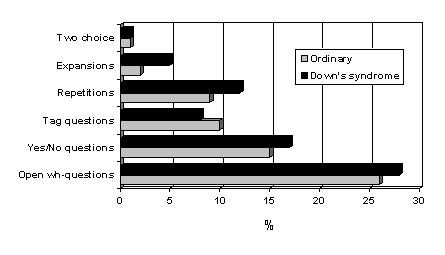
Figure 1. Histogram showing composition of maternal language addressed to typically developing children and children with Down syndrome.
In the group with Down syndrome, the percentage of mothers' utterances that were wh-questions and closed questions were approximately equal (28.2% and 27.1% respectively). Yes / no questions, tag questions and two choice questions were all considered to be closed questions. This was also true in the typically developing group where mothers' utterances consisted of 26.4% open wh-questions and 26.0% closed questions.
The general trend was that wh-type questions tended to elicit more utterances that were > 4 morphemes than closed questions did. However, there were significant individual differences in the type of maternal question preceding these longer utterances. Six out of eighteen children went against this trend; they responded with longer utterances more often when preceding maternal utterance was a closed question rather than a wh-question.
Children with Down syndrome responded to 68% of mothers yes / no questions and tag questions, with either no verbal response or one word (yes or no). Ordinary children responded to 74% of mothers yes / no questions and 75% of mothers tag questions in the same manner.
| Preceding maternal utterance | Percentage of children's utterances >4 morphemes | |
|---|---|---|
| Down syndrome | Ordinary | |
| Wh-question | 46.6 | 40.1 |
| Closed question | 24.0 | 26.8 |
Discussion
The results of the analysis of children's speech revealed that children with Down syndrome had shorter MLUs than ordinary children matched for level of comprehension. Comparison of mothers' speech revealed that mothers of children with Down syndrome engaged in more repetitions and in more expansions and corrections of their children's utterances than mothers of typically develolping children did. Significant differences were not found in the amount of wh-type questions, yes / no questions, tag questions or two choice questions asked by mothers.
The results also showed that, in general, a greater percentage of children's longer utterances (> 4 morphemes) occurred when the preceding maternal utterance was a wh-type question compared to a closed question. Almost three quarters of mothers closed questions received either no verbal response from the child, or a single word answer.
The findings that the MLUs of children with Down syndrome were significantly shorter than those of typically developing children, is consistent with previous literature reporting verbal ability limited mainly to single word utterances (Bray et al, 1988), or the reliance, in children with Down syndrome, on short simple sentences with low syntactic structure (Weigel - Crump, 1981).
The present study also provides support for Miller' s (1987) finding of asynchronous development of productive language relative to language comprehension in children with Down syndrome. Children with Down syndrome were matched with typically developing children on comprehension level. In all but two of these pairs, the typically developing children had significantly larger MLU than the child with Down syndrome. Two children with Down syndrome (Lucy and Lynne) had anomalously high MLU compared to the rest of the group. Lucy (age 7), had a MLU of 4.84 which was equal to the matched child's MLU of 4.83. As Miller (1987) found, not all children show the same profile of development. Two profiles account for 96% of the data.
- A flat profile where cognition and language development and production are equivalent.
- A profile of delayed language production with language comprehension equal to cognitive status.
The results indicate that Lucy may fit profile 1, where language comprehension and production are equal, whereas the eight other children with Down syndrome appear to fit profile 2, where language production is delayed relative to language comprehension. A similar pattern of distribution was also reported by Miller. Profile 2 accounted for 60 to 75% of subjects older than eighteen months of chronological age, whereas profile 1 accounted for 25 to 40% of subjects.
The second child with Down syndrome with a much higher than average MLU was Lynne. Lynne was the oldest child in the study at 13 years, 7 months. Age may therefore, explain her advanced productive ability. Being that much older, Lynne would have had more opportunity to experience and use her language as well as a wider and slightly different social environment.
Mothers of children with Down syndrome did engage in more repetitions of their children's utterances than mothers of typically developing children. This study was interested in how unintelligible speech affect mother - child conversations. It was hypothesised that because children with Down syndrome often fail to produce clear speech, mothers will repeat back the child's utterances to confirm that they have understood (or indicate when they have not). The following extract from Mike shows how unintelligible speech can distort and halt the normal pattern of interaction.
- M. And did you eat it all up?
- C. Yep. Guess what?
- M. What?
- C. I got some train count.
- M. Got changed to go out?
- C. No, choo-choo trains.
- M. Oh, trains.
- C. Mmm trains.
- M. To go out where?
- C. No, not go out, got count.
- M. What you on about? Oh, count trains.
- C. Count trains.
The recordings supported an observation made by Bray (1988). Intelligibility is very dependent upon the listener's knowledge of context and consequently those children who did not initiate or elaborate to any extent were more easily interpreted. Mike introduced new topics of conversation on several occasions which led to a breakdown in understanding until the mother had cued in on the topic.
Repair strategies are used by individuals when they are aware of a lack of understanding by the other person of the meaning being conveyed in discussion. The children with Down syndrome were aware most of the time when they were being misunderstood. Mike was able to clarify his meaning in the following extract by replacing the misheard word "dolls" with "cindys".
- M. What will they play?
- C. They play dolls.
- M. Trolls?
- C. No.
- M. No. What?
- C. Cindys.
- M. Cindys, oh. And what will they do with the cindys?
Unfortunately, most of the children only had limited strategies at their disposal to repair any breakdown, and often numerous conversational turns were required before the conversation was repaired, as in the following extract.
- C. June. Next summer. I mean in the autumn come. Now my others are growing.
- M. What's growing?
- C. Mine.
- M. You're growing?
- C. My watercress.
- M. Your brother?
- C. No, I mean in the kitchen.
- M. Oh, your seeds.
- C. Seeds.
- M. The seeds, yes. We planted some seeds.
In one sense the transcripts give a misleading impression of what is taking place. Having the luxury of videotaped recording enables researchers to go over a child's utterances many times to help work out what is being said as fully as possible. This is of course far removed from the reality of the interaction. The mother must respond in real time to what the child says with only 'mental' re-runs of the interaction for consultation. On many occasions I was only able to work out what the child had said after many re-runs of the tape, and by relating the child's utterance to the mothers response. Though the mothers knowledge of their child provided them with a better basis for understanding than an 'outsider', the recording showed that they still found it difficult to comprehend what was said to them, more than occasionally.
Horstmeier (1985) found that mothers of school age children and adolescents with Down syndrome understand about twice as much of their children's speech as an observer. If mothers accept so much of their children's unintelligible speech, these older children may not be getting the feedback they need to produce clearer language. Horstmeier suggests that adults may need to politely indicate to a youth with Down syndrome when they cannot understand. Bray (1988) also suggests that children should be taught to cope with the misunderstandings, misinterpretations and lack of sympathy that they will encounter in the unspecified and unknown language of the outside world. Bray suggests the use of role play and desensitisation techniques.
The data from the present study indicates that intelligibility is a problem facing all nine of the children with Down syndrome. However, there were large individual differences in the quality of speech produced. It has been reported that children with more words in a sequence are often at a disadvantage due to poor intelligibility which increases with increasing complexity of syntax (Bray, 1988). However, in the present study I had greatest difficulty understanding the speech of the two children with the shortest MLUs. Lucy, who had the longest MLU of the Down syndrome group produced particularly clear speech.
Although mothers of children with Down syndrome engaged in significantly more expansions and corrections of their children's utterances than mothers of typically developing children, they were still relatively infrequent, accounting for on average, only 4.9% of the mothers utterances. This is a welcoming finding following studies by Cazden (1977). Cazden has shown that when children are treated more like 'equal partners' in discourse, where what they say is used as a basis for conversation, children show more rapid language development than do children who have what they say repeated back to them in 'better grammar' for example.
Two choice questions were also relatively infrequent with all mothers accounting for less than 1% of their utterances. Wood et al (1986) suggested the 'ease' with which two choice questions can be answered underlies the difficulties both parents face, in knowing whether or not mutual understanding has occurred. The recordings obtained in this study also suggest that in many cases the child responded to the two choice questions but without really understanding them. Children often agreed with both choices.
- M. Did you do some writing with Mrs. Capon?
- C. Yes, writing.
- M. Or reading?
- C. Reading.
- M. Did you put feathers on?
- C. Yes.
- M. Or just painted them?
- C. Painted.
- M. Did it wobble?
- C. Yeh.
- M. And what colour?
- C. Red.
- M. Did you have anything on your jelly?
- C. Green.
- M. Cream?
- C. Green.
- M. It was green jelly? Come on, was it green or was it red?
- C. Red.
- M. Come on. What colour was this jelly? What colour jelly?
One conclusion that can be drawn from these results is that mothers had experienced previous confusion with two choice questions and therefore refrained from using them.
Mothers of children with Down syndrome did not ask fewer wh-type questions than mothers of typically developing children. They were relatively frequent, accounting for just over a quarter of maternal utterances in both groups. Wh-questions are often put forward as important tools for extending children's understanding, encouraging them to reflect, and helping them to decontextualise their thinking (Dillon, 1982). However, questions may be more or less demanding intellectually. Blank et al (1978) for example, have provided a classification of teachers language in terms of the level of cognitive demand it embodies for young children. Low level demands include questions on topics such as the names of objects and their attributes - size, shape, colour and so forth. More demanding discourse includes attention to attributes that enable objects to be related, classified, grouped and distinguished. Such questions draw attention to more abstract relationships between objects and events. The most cognitively demanding language in Blank's scheme involves reasoning, speculating, planning and so on (Wood et al, 1986).
Although mothers of children with Down syndrome did not ask fewer wh-type questions, it is possible that those they did ask were less cognitively demanding. In the present study only the frequency of wh-type questions and not their complexity, were considered. A more complex analysis of the cognitive demand of the wh-type questions is a possible area for further study.
Mothers of children with Down syndrome did not ask more closed questions than mothers of typically developing children. It was hypothesised that mothers of children with Down syndrome would ask more questions requiring only a yes or no answer because of the ease with which they can be answered and because they generate responses which seem intelligible. Contrary to the assumptions behind this research it would appear that mothers of children with Down syndrome were not making the task of conversation easier for their children than were mothers of typically developing children at the same level of understanding.
The results of this analysis show the composition of maternal language to children with Down syndrome and typically developing children to be remarkably similar. Both sets of mothers language consisted of predominantly wh-type questions and closed questions (tag questions and yes / no questions). Two choice questions and expansion were relatively infrequent in both groups. This similarity in maternal language occurred despite the superiority of the typically developing children in terms of their longer MLUs.
Some theorists have argued that grammatical fine tuning represents a form of indirect language teaching whereby adults present children with examples of language that are just beyond their current levels of production to help 'model' or provide support for the next step in their progress (Snow, 1979). An alternative interpretation of the same phenomenon places far more emphasis on the child's naturally developing abilities. The changes in adult speech represent accommodation to the child's developing competence (Gleitman et al, 1984). From this perspective adults change what they talk about, and how they talk, to fit in with the child's abilities to understand, but such adjustments follow rather than lead the child on to the next stage.
The results of the present study support Gleitman's position, suggesting that mothers are not directing their speech to the child's production level, but to their level of comprehension. The results show that the typically developing children have greater productivity than the children with Down syndrome. If mothers were adjusting their language to their children's language production, differences in the maternal language of the two sets of mothers would be expected, but few were found. The composition of the maternal language in the two groups was essentially the same.
The overall picture is that most conversations between mothers and children were characterised by question - answer exchanges, with nearly all of the questions coming from the mothers. One advantage of such a strategy is that it enables the mother to establish and develop the theme of conversation, and to maintain coherence in discourse. Her questions produce the framework into which the child's responses fit and can be related back to preceding utterances. Questions may establish who or what is being talked about and then proceed to establish things about that topic, such as who did what, when , with whom and with what consequences. From the child's point of view this means that he can often participate in the interaction by attending to each question as a single event, taking little or no responsibility for the task of constructing a coherent conversation. Thus questions, by their nature, are 'demanding' and 'controlling'. Constant cycles of question - answer exchanges are unlikely to provide conditions for a child to learn how to develop skills and abilities in creating realms of discourse. The recording in this study contained very few examples of children even attempting to produce autonomous discourse.
Whilst considering these results it must be acknowledged that the conversations being considered were being produced on demand and in front of a video camera and therefore lack ecological validity. For example, Wells, (1979), in a study of language in the home, reported that the three year old initiates about three quarters of the verbal interactions with his parents. In the present study, adult initiated conversation predominated. The presence of a researcher and a video camera may have contributed to the mothers apparent eagerness to construct a coherent discourse, and thus lead them to utilise a questioning framework.
Even though the conversations lack ecological validity, they serve to illustrate the effects of different maternal utterances on child responsiveness. Any attempt to study the acquisition of language without due attention to interactions between speakers, misses the very thing it seeks to study. Therefore, the effects of certain question types used by mothers on the length of the children's following utterances were investigated.
Firstly, the results highlighted the inhibiting effect of closed questions on the children's following response. Children with Down syndrome responded to 68% of mothers yes / no questions and tag questions, with either no verbal response (i.e. a nod or shake of the head) or with a single word (e.g. yes or no). The pattern was very similar with ordinary children who responded to 74% of mothers yes / no questions and 75% of mothers tag questions in the same manner. Such results suggest that mothers should reduce the number of closed questions in their speech if their aim is to get children talking and showing initiative. Perhaps rather than directing the conversation by questions she should be prepared to inform, react, listen and acknowledge.
Secondly, it was found that wh-type questions tended to elicit more utterances that were > 4 morphemes, than closed questions did. On average 43.4% of children's utterances that were > 4 morphemes occurred when the mothers preceding utterance was a closed question. Although wh-questions are still demanding and controlling, their effects on children's talkativeness are not as negative as closed questions.
Surprisingly, six out of eighteen children went against this general trend and responded with longer utterances more often when the preceding maternal utterance was a closed question rather than a wh-question. This may have been an effect of including tag questions in the closed question category. Wood et al (1986) reported that young children tend to respond to tag utterances such as "strawberry's are delicious, aren't they?" as genuine yes / no questions. Many children in the present study also did so. However, tag utterances are really hybrid moves consisting of both contribution and question. Although the present study did not consider personal contributions, Wood et al (1986) found that deaf children showed more initiative and were more talkative when teachers concentrated on telling children about their own experiences or commenting on what the child had to offer.
Lynne for example, appeared to treat tag utterances not as genuine questions requiring an answer but as contributions to the conversation. Consequently she would often add a contribution of her own as in the following extract.
- M. Set the fire alarm off, didn't he?
- C. Why did he? And the police come to see if we were alright.
- M. That's right. That was a busy day, wasn't it?
- C. What a busy day then. And don't do it again. Don't do it again.
- M. No, I'm not going to.
- C. Dad, if that happened to me I'd be sent to hospital.
- M. You would, yeh. You've knocked yourself out before, haven't you?
Lynne picked up on contributions and pursued them, asking questions and reacting in other ways. The result was a more interesting shared construction of stories to which both mother and child contributed. A less directive linguistic environment may have attributed to Lynne's apparent eagerness to communicate. The language addresses to Lynne contained 5% more tag utterances and 10% less wh-questions than the average figures in the Down syndrome group.
Another maternal utterance type that was not statistically analysed in this study but which appear important, are phatics. Phatics are used to convey general sociability rather than communicate speech. Some examples are "yes", "really", "ah-ha" and "that's nice". Wood et al (1986) asked teachers to sit back, and as far as possible, say nothing substansive. The teachers silence ultimately forced the deaf children to take over. Once the children began to converse the average mean length of turns doubled. Unfortunately, because the teachers played a minimum role the children's offerings were often difficult to decipher, because they would leap from topic to topic without establishing any intelligible connection between them. Examples of this were found in the present study. The mother of Natalie made effective use of phatics in between questioning and on most occasions they lead to longer responses from the child. As well as phatics being low in control they serve to fill a gap and give the child time to generate a response before the topic of conversation is changed by the mother. Mothers in this study tended to leave rather short silences between their utterances. Wood et al (1986) also found that children needed more time to respond. When teachers were helped to extend their pauses to three seconds using an electronic buzzer, longer and more thoughtful responses were obtained from the children. It is possible that mothers are judging the time children need by the speed of their own thought processes and speech rates, when they may need to hold back and leave longer pauses. In the following extract, Natalie's mother makes use of phatics in between tag utterances and wh-questions, which gives Natalie time to add comments. However, because control is lower, the discourse is more difficult to comprehend.
- M. You're a Rainbow Guide aren't you?
- C. No.
- M. No.
- C. No, not Rainbows. When we go rainbows.
- M. Mmm.
- C. and where was it where started Brownies.
- M. Oh, yes. You're going to Brownies in September.
- C. September.
- M. What will you wear when you got to Brownies?
- C. My hat, my top and trousers.
- M. What colour?
- C. Blue, yellow arm. I like that one on today. Me now bike with it. Now bike today. We'll ride back home. Me back home myself. No man no long.
- M. Mmm.
- C. And now I don't want to start Brownies at seven. Never me June. Next summer. I mean in the autumn come. Now my others are growing.
- M. What's growing?
A further observation was that many mothers spoke in long strings of utterances. They often answered for the child, failed to leave time for a response, and changed the topic before the child had made a verbal contribution. The mother of Tony appeared happy to accept just one or two words as the child's contribution between her strings of highly controlling questions as can be seen in the following extract.
- M. Oh, that's for your Christmas thing isn't it? All the mummies and daddies are going to come and see that aren't they? What else did you do? Did you have lunch? Yeh, what else did you have for your lunch?
- C. Sandwiches.
- M. Sandwiches.
- C. Crisp.
- M. Yes.
- C. Two crisps.
- M. Two crisps. Oh. Did you have your drink? No, did you not have a drink? You don't like your drink, do you? You always bring it home, don't you? Did you go swimming today? Why not?
- C. Didn't do.
- M. Didn't you have it today? What else did you do? Where did you go after school? Where did you go? Where did you go for this?
Mothers often paraphrased themselves and their own conversational turns often contained strings of different utterance types and repeated questions. Therefore it was difficult to analyse the effect of different maternal utterance types on the child's responsiveness and length of utterance. In the analysis it was assumed that the child was responding to the final maternal utterance within her conversational turn.
Conclusion
Certain aspects of the maternal style are responses to the nature of the disability (particularly intelligibility) and are likely to distort the structure of interaction by evoking natural but often counter productive responses from the adults, if they become too frequent in maternal speech. Therefore, mothers of children with Down syndrome need an extra awareness of the techniques they use to converse with their children. They should be made aware that question following question in an unbroken sequence of control effectively inhibits children from trying to produce coherent lengthy accounts. Reducing the frequency of questions requiring only a yes or no answer and giving children more time to think and communicate after they have addressed them, may help children to show more initiative and produce longer responses.
Acknowledgement
The authors wish to express their thanks to the mothers and children who took part in this study.
References
- Berger, J. and Cunningham, C.C. (1983) Development of early vocal behaviours and interactions in Down syndrome and non-handicapped infant-mother pairs. Developmental Psychology. 19, 322-331.
- Bishop, D.C. (1983) Test for Reception of Grammar. University of Newcastle upon Tyne.
- Blank, M., Rose, S. and Berlin, L. (1978) The Language of Learning: The Pre-School years, Grune and Stratton, New York.
- Bray, M. and Woolnough (1988) The language skill of children with Down syndrome ages 12-16 years. Child Language Through Teaching and Therapy, vol. 4, issue 3, 311-324.
- Brooks-Gunn, J. and Lewis, M. (1984) Maternal responsiveness in interactions with handicapped infants. Child Development. 55, 782-793.
- Brown,R. (1973) A First Language. Cambridge: Harvard University Press.
- Buckhalt, J.A., Rutherford, R.B. and Goldberg, K.E. (1978) Verbal and non-verbal interactions of mothers and their Down syndrome and non-retarded infants. American Journal of Mental Deficiency. 82, 337-343.
- Buckley, S. and Sacks, B. (1986) The adolescent with Down syndrome: life for the teenager and for the family. In Buckley, S., Emslie, M., Haslegrave, G. and Le Prevost, P. (eds). The Development of Language and Reading Skills Children with Down Syndrome. Portsmouth Polytechnic.
- Buium, N., Rynders, J. and Turnure, J. (1974) Early maternal linguistic environment of normal and Down syndrome language-learning children. American Journal of Mental Deficiency. 79(1) 52-58.
- Cazden, C. (1977) Concentrated versus contrived encounters. In Language and Learning in Early Childhood Education (Ed A. Davies) Social Science Research Council, London.
- Coggins, T.E., Carpenter, R.L. and Owings, N.O. (1983) Examining early intentional communication in Down syndrome and non-retarded children. British Journal of Disorders of Communication, 18, 98-106.
- Coggins, T.E. and Stoel-Gammon, C. (1982) Clarification strategies used by four Down syndrome children for maintaining normal conversational interaction. Education and Training of the Mentally retarded. 17, 65-67.
- Cook, A.S. and Culp, R.E. (1981) Mutual play of mothers with their Down syndrome and normal infants. International Journal of rehabilitation Research. 4(3), 542-544.
- Crawley and Spiker (1983) Mother child interactions involving two year olds with Down syndrome. A look at individual differences. Child Development, 54, 1312-1323.
- Cross (1977) Mothers' speech adjustments: the contribution of selected child listener variables. In Snow and Ferguson (1977)(Eds). Talking to Children: Language Input and Acquisition. Cambridge. Cambridge University Press 133.
- Cunningham, C. (1982) Down Syndrome: An Introduction for Parents. London. Souvenir Press.
- Dillon, J.T. (1982) The effect of questions in education and other enterprises. Journal of Curriculum Studies, 14, 127-165.
- Eheart, B.K. (1982) Mother-child interactions with non-retarded and mentally retarded pre-schoolers. American Journal of Mental Deficiency 87, 20-25.
- Fowler, A. (1988) Determinants of rates of language growth in children with Down syndrome. In Nadel,L.(Ed)(1988) The Psychobiology of Down Syndrome. New York: National Down Syndrome Society USA, MIT Press.
- Gleitman, L.R. Newport, E.L. and Gleitman, H. (1984). The current status of the motherese hypothesis. Journal of Child Language, 11, 75-76.
- Harris, J. (1983) What does mean length utterance mean? Evidence from a comparative study of normal and Down syndrome children. British Journal of Disorders of Communication. 18, 153-169.
- Horstmeier, D.S. (1985) The Mother-Child Communicative Interactions of Educationally Advantaged Down Syndrome and Normal Children Matched for Auditory Comprehension. Unpublished doctoral dissertation. Ohio State University.
- Horstmeier, D.S. (1988) "But I Don't Understand You"-The Communication Interaction of Youth and Adults with Down Syndrome
- Jeffree, D., Wheldall, K. and Mittler, P. (1973) The facilitation of two word utterances in two Down syndrome boys. American Journal of Mental Deficiency, 78, 117.
- Jones,O. (1979) A comparative study of mother-child communication with Down syndrome and normal infants. In Schaffer,D. and Dunn,J. (Eds). The First Year of Life. New York. John Wiley and Sons 175-195.
- Kogan, K., Wimberger, H. and Bobbit, R. (1969) Analysis of mother-child interaction in young mental retardates. Child Development. 40, 799.
- Marshall, N., Hegrenes, J. and Goldstein, S. (1973) Verbal interactions: mothers and their retarded children versus mothers and their non-retarded children. American Journal of Mental Deficiency. 77, 415.
- Miller, J.F. (1988) The development asynchrony of language development in children with Down syndrome in Nadel, L. (Ed)(1988). The Psychobiology of Down Syndrome. New York: National Down Syndrome Society USA, MIT Press.
- Miller, J., Chapman, R. and MacKenzie, H. (1981) Individual Differences in the Language Acquisition of Mentally Retarded Children. Paper presented at the 2nd international congress for the study of child language, Vancouver BC, Canada.
- Miller, J., Streit, G., Salmon, D. and La Follette, L. (1987) Developmental Synchrony in the Language of Children with Down Syndrome. Paper presented at the annual convention of the American Speech-Language-Hearing association, New Orleans, La. USA.
- Miller, J.F. (1987) Language and communication characteristics of children with Down syndrome. In S.M. Pueschel, C. Tingey, J.E. Rynders, A.C. Crocker and D.M. Gutcher (Eds) New Perspectives on Down Syndrome. Baltimore. M.D. Brookes 232-262.
- Mittler, P. and Berry, P. (1977) Demanding language. Research to practice in mental retardation. Education and Training Vol 11.
- Moerk, E.L. (1976) Processes of language teaching and training in the interactions of mother-child dyads. Child Development, 47, 1064-1078 p72.
- O'Kelly-Collard, M. (1978) Maternal linguistic environment of Down syndrome children. Australian Journal of Mental Retardation. 5(4), 121-126.
- Peterson, G.A and Sherrod, K.B. (1982) Relationship of maternal language development and language delay of children. American Journal of Mental Retardation. 86(4), 391-398.
- Philips, J. (1973) Syntax and vocabulary of mothers' speech to young children: age and sex comparisons. Child Development. 44 182-185 pp70-78.
- Rogers, M. (1975) A study of language skills in severely sub-normal children. Child: Care, Health and Development. 1, 113-126.
- Rondal, J.(1977) Maternal speech in normal and Down syndrome children. Research to Practice in Mental Retardation. Education and Training, Vol. 11.
- Rondal, J. (1978) Maternal speech to normal and Down syndrome children matched for mean length of utterance. In Meyers, C. (Ed). Quality of Life in Severely and Profoundly Mentally Retarded People. Research foundations for improvement (pp 193-266) Washington DC. American Association of Mental Deficiency.
- Snow, C. (1972) Mothers' speech to children learning language. Child Development. 43, 549-565.
- Snow, C. (1986) Conversions with children. In Fletcher, P. and Garman, M. (Eds) Language Acquisition. Cambridge. 2nd ed. 1986.
- Stevenson, M.B. and Leavitt, L.A. (1983) Mother-Infant Interaction: A Down Syndrome Case Study. Paper presented at the 2nd international workshop on the 'at risk' infant. Jerusalem.
- Weigal-Crump, C.A. (1981) The development of grammar in Down syndrome children between the mental ages of 0-2 and 6-11 years. Education and Training of the Mentally Retarded. Feb 24-30.
- Wells, G. (1979) Variation in child language. In Fletcher, P. and Garman, M. (Eds) Language Acquisition. Cambridge. 2nd ed. 1986.
- Wood, D., Wood, H., Griffiths, A. and Howarth, I. (1986) Teaching and Talking with Deaf Children. John Wiley and Sons.