







The relevance of a nonword repetition task to assess phonological short-term memory in individuals with Down syndrome
Phonological short-term memory capacity is generally measured with a word span task or a digit span task. Another way to measure it is to use a nonword repetition task. Gathercole and Adams (1993) claimed that this procedure can be used with children as young as two-years old. It seems that in normally developing children the quality of nonword repetition is influenced both by the length of nonwords and by the degree of wordlikeness. Can the phonological short-term memory of individuals with Down syndrome be assessed with a nonword repetition task? In order to answer this question, we decided to replicate Gathercole and collaborators' experiments (1991,1993) but with individuals with Down syndrome. The quality of nonword repetition in individuals with Down syndrome is, as in normally developing children, influenced both by the length of nonwords and by their degree of wordlikeness. Furthermore, our results seem to confirm the hypothesis which states that nonwords are temporarily stored in the phonological short-term memory system. As this system has a limited capacity, both normally developing children and people with Down syndrome recall more short nonwords than long nonwords. In conclusion, nonword repetition is a reliable task with which to assess phonological short-term memory in individuals with Down syndrome as well as in normally developing children.
Comblain, A. (1999) The relevance of a nonword repetition task to assess phonological short-term memory in individuals with Down syndrome. Down Syndrome Research and Practice, 6(2), 76-84. doi:10.3104/reports.98
Introduction
Gathercole and Baddeley (1990) and Gathercole, Emslie, Willis and Baddeley (1991) suggested that nonword repetition allows a purer measure of short-term memory abilities than classic memory span tasks (i.e., digit span and word span). The probability that subjects use their lexical knowledge in order to facilitate recall is higher in the case of digits and familiar words than in the case of non-familiar phonological forms such as nonwords. This assertion has been discussed by some researchers (cf. Snowling, Chiat & Hulme, 1991; Hulme Maughan & Brown, 1991) and it is generally accepted that lexical knowledge also influences the quality of nonword repetition (see Gathercole, 1995 and Baddeley, Gathercole & Papagno, 1998 for a review of the literature). Gathercole, Emslie, Willis and Baddeley (1991, 1992) and Gathercole (1995) suggested that the relationship between nonword repetition and lexical knowledge can be explained in two different ways. The first explanation is called the linguistic hypothesis : children with high lexical knowledge are able to repeat more nonwords than children with low or limited lexical knowledge. They assumed that children with high lexical knowledge can benefit from the presence of familiar phonological segments (assimilated to some morphemes of their first language) in the nonwords in order to facilitate repetition. Children with low lexical knowledge cannot benefit in the same way from these segments. According to this hypothesis, the lack of morpheme knowledge limits nonword repetition performance. This hypothesis seems to be reinforced by the research of White, Power and White (1989) who showed that children often used familiar morphological components in order to guide the semantic interpretation of non-familiar words. The second explanation is called the mnesic hypothesis : subjects use the short-term memory representations of nonwords (or of the non-familiar phonological forms) to build permanent lexical representations of the phonological forms.
In order to test these two hypothesis, Gathercole and collaborators created a list of 40 nonwords. The nonwords differed from the others by several features: the length (1 to 4 syllables), the articulatory complexity (composed of single consonants or of consonant clusters) the degree of resemblance with a real English word (on a graduated 5 level scale) and the number of lexical and grammatical morphemes contained in the nonwords. If the mnesic hypothesis is correct, the shorter nonwords will be the most easily repeated (according to the word length effect; Baddeley, Thomson & Buchanan, 1975; Baddeley, 1986). If the linguistic hypothesis is correct, the number of familiar segments contained in the nonwords will influence the quality of the repetition. In other terms, the more 'wordlike', the nonwords are, the better they will be repeated. Gathercole and collaborators think that a third situation can occur: nonword length and linguistic familiarity can both influence the quality of repetition. In such a case, one will be confronted with a more complex model in which nonword repetition will be influenced both by phonological short-term memory abilities and by the subjects' lexical knowledge. This is effectively what Gathercole and collaborators found.
If nonword repetition is a reliable test of young children's short-term memory abilities, one might ask whether this task is equally relevant to test the short-term memory abilities of individuals with Down syndrome. In her 1998 study, Laws showed that nonword repetition is a reliable measure of phonological short-term memory in children and adolescents with Down syndrome. Futhermore, she noticed that nonword repetition performance in subjects with Down syndrome can predict language comprehension and reading ability. Nevertheless, two more questions can be asked regarding the nonword repetition task:
- How is the quality of nonword repetition in individuals with Down syndrome related to the length, to the degree of wordlikeness, and to the structural complexity? In other words, do phonological short-term memory capacity, long-term lexical learning and articulatory competence respectively influence the accuracy of nonword repetition ?
- Is the pattern of results obtained by individuals with Down syndrome the same as that observed in normally developing children? In other words, is nonword repetition in Down syndrome also influenced both by the length and the degree of wordlikeness?
Method
Participants
Thirty six subjects with Down syndrome were individually tested. All were native French speakers. Their chronological age (CA) ranged from 6 years and 10 months to 42 years and 10 months (mean: 19;8 years-old). Their mental age (MA) ranged from 3 years 2 months to 7 years 8 months (mean: 4;4 years-old). The mental age was calculated with the Echelles Differentielles d'Efficience Intelectuelle (E.D.E.I.; Perron-Borelli, 1974). The subjects can be divided into three sub-groups according to their chronological age.
| Group | ||||
|---|---|---|---|---|
| Children (N=9) | Adolescents (N=13) | Adults (N=9) | ||
| Chronological age (Years; months) | Mean | 9;2 | 18;5 | 28;8 |
| Range | 6;10-11;3 | 14;5-21;8 | 22;3-42;10 | |
| Mental age (Years; months) | Mean | 3;5 | 5;1 | 4;8 |
| Range | 3;1-3;7 | 3;6-7;8 | 3;3-5;11 | |
Procedure
Subjects were asked to repeat 40 nonwords composed of 1, 2, 3 or 4 syllables (see Appendix for the list of nonwords).
The nonwords were orally presented. Half contained single consonants and half consonants in clusters. The subjects were asked to repeat each nonword immediately after the examiner. A nonword was considered as correct if it was repeated without any omission, substitution or addition of sound. Systematic sound distortions (i.e. sigmatism) were not considered as errors.
The nonwords were evaluated for their degree of resemblance with real French words (degree of 'wordlikeness') by twenty non-disabled French speaking adults. The task was to estimate on a five level graduated scale the degree of wordlikeness of each nonword. A score of '1' represented a low level of wordlikeness and a score of '5' represented a high degree of wordlikeness.
| 40 nonwords | |||||||
| 20 with single consonants (initial, middle and final) | 20 with consonant clusters (initial, middle and final) | ||||||
| 1 syllable | 2 syllables | 3 syllables | 4 syllables | 1 syllable | 2 syllables | 3 syllables | 4 syllables |
Figure 1. Nonwords structure
Results
The mean repetition score of the whole group was 16.97 nonwords (standard deviation -SD- : 10.21). The mean repetition score of the children with Down syndrome was 11.00 nonwords (SD: 2.52), the score of the adolescents was 18.71 nonwords (SD: 10.21) and the score of the adults was 18.64 nonwords (SD: 11.39).
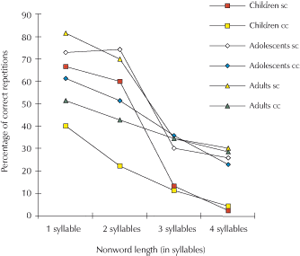
Figure 2. Percentage of correct repetitions in the three subgroups of DS subjects according to the nonword length and the articulatory complexity (sc = single consonant, cc = consonant cluster).
In all statistical analyses the significance level was fixed at p<0.05. When it was indicated, we used an a-posteriori Newman-Keuls test (comparison of means).
A significant correlation between the subjects' MA and their nonword repetition performance (r = 0.67, p<0.0001) was observed, but no significant correlation was found between CA and nonword repetition performance.
As can be seen in Figure 2, subjects repeated more short nonwords than long nonwords. More precisely, the most accurately repeated nonwords contained 1 or 2 syllables and single consonants. The nonwords containing more than 2 syllables and consonant clusters were the least accurately repeated.
| Nonword length | Correct repetitions | Standard deviation |
|---|---|---|
| 1 syllable | 63.51% | 17.20 |
| 2 syllables | 55.14% | 19.16 |
| 3 syllables | 38.38% | 12.95 |
| 4 syllables | 21.08% | 13.59 |
The whole group
We conducted a two way ANOVA on our data. The dependent variable was the 'percentage of correct repetitions', the first independent variable was the 'nonwords length' (4 levels: 1, 2, 3, or 4 syllables) and the second independent variable was the 'consonant complexity' (2 levels: single consonant, consonant cluster). We observed a significant effect of the variable 'nonword length' [F(3,32) = 22.66, p<0.0001)], a significant effect of the variable 'consonant complexity' [F(1,32) = 8.35, p<0.01], and a significant interaction between both variables [F(3,32) = 3.00, p<0.05].
A-posteriori comparisons of the means indicated that one and two syllable nonwords were better repeated than three and four syllable nonwords (p<0.01 in each case). The mean repetition scores for one and two syllable nonwords were not statistically different. The mean repetition scores for three and four syllable nonwords were not statistically different.
Nonwords containing single consonants (mean: 48.24%, SD: 27.65) were better repeated (p<0.01) than nonwords containing consonant clusters (mean: 35.81 SD: 17.25).
There was a significant interaction between the variable 'nonword length' and the variable 'nonword complexity'.
The mean values shown in Table 3 were compared with Newman-Keuls a-posteriori tests.
| Nonword length | Complexity: single consonants | Standard deviation | Complexity: consonant clusters | Standard deviation |
|---|---|---|---|---|
| 1 syllable | 74.59% | 11.87 | 52.43% | 14.75 |
| 2 syllables | 69.19% | 16.28 | 41.08% | 8.20 |
| 3 syllables | 27.57% | 5.86 | 19.19% | 18.47 |
| 4 syllables | 21.62% | 18.82 | 20.54% | 7.78 |
1. Nonwords of the same length but of different consonant complexity
One and two syllable nonwords containing single consonants were better repeated than one and two syllable nonwords containing consonant clusters (respectively, p<0.05 and p<0.01). Repetition scores for three and four syllable nonwords containing single consonants did not differ significantly from repetition scores for three and four syllable nonwords containing consonant clusters.
2. Nonwords of the same consonant complexity but of different length
The mean percentage of correct repetitions for one and two syllable nonwords containing single consonants did not differ significantly. The mean percentage for correct repetitions of three and four syllable nonwords containing single consonants did not differ significantly. One and two syllable nonwords containing single consonants were better repeated than three and four syllable nonwords containing single consonants (p<0.01 in each case). One syllable nonwords containing consonant clusters were better repeated than three and four syllable nonwords (respectively p<0.05 and p<0.01). The other means did not differ significantly.
The subgroup of children
The same two way ANOVA that was previously conducted on the whole sample, was repeated for the children sub-group data. There was a significant effect of the variable 'nonword length' [F(3,32) = 13.98, p<0.0001)] and a significant effect of the variable 'consonant complexity' [F(1,32) = 6.52, p<0.05]. There was no significant interaction between the two variables.
| Nonword length | Correct repetitions | Standard deviation |
|---|---|---|
| 1 syllable | 53.33% | 28.11 |
| 2 syllables | 41.11% | 32.73 |
| 3 syllables | 12.22% | 9.73 |
| 4 syllables | 3.33% | 7.50 |
A-posteriori comparisons of the means indicated that one and two syllable nonwords were better repeated than three and four syllable nonwords (p<0.01 in each case). The mean repetition scores for one and two syllable nonwords did not differ significantly. The mean repetition scores for three and four syllable nonwords did not differ significantly.
Subjects repeated more nonwords containing single consonants (mean: 35.56 %, SD: 35.80) than nonwords containing cluster consonants (mean 19.44 %, SD: 20.35) (p<0.01). The absence of significant interaction between the variable 'nonword length' and the variable 'nonword complexity' did not allow us to conduct an a-posteriori mean comparison test on our results. However, Table 5 shows that the mean percentages of correct repetitions tended to decrease as the number of syllables and the nonwords' complexity increase.
| Nonword length | Complexity: single consonants | Standard deviation | Complexity: consonant clusters | Standard deviation |
|---|---|---|---|---|
| 1 syllable | 66.67% | 26.06 | 40.00% | 25.58 |
| 2 syllables | 60.00% | 36.52 | 22.22% | 13.61 |
| 3 syllables | 13.33% | 9.30 | 11.11% | 11.11 |
| 4 syllables | 2.22% | 4.97 | 4.44% | 9.94 |
The subgroup of adolescents
The same two way ANOVA that was previously conducted, was again conducted on the adolescents subgroup data. There was a significant effect of the variable 'nonword length' [F(3,32) = 14.58, p<0.0001)]. Contrarily to what we observed in the two previous groups, there was no significant effect of the variable 'consonant complexity'. There was no significant interaction between the two variables.
| Nonword length | Correct repetitions | Standard deviation |
|---|---|---|
| 1 syllable | 67.14% | 14.75 |
| 2 syllables | 62.86% | 17.10 |
| 3 syllables | 32.86% | 20.26 |
| 4 syllables | 24.29% | 19.69 |
A-posteriori comparisons of the means indicated that one and two syllable nonwords were better repeated than three and four syllable nonwords (p<0.01 in each case). The mean percentages of repetition of one and two syllable nonwords did not differ significantly. The mean percentages of repetition of three and four syllable nonwords did not differ significantly.
There was no significant effect of the variable 'consonant complexity'. Nonwords containing single consonants were repeated as well as nonwords containing consonant clusters. The mean percentage of correct repetitions for simple nonwords was 50.72% (SD: 27.80) and the mean percentage of correct repetition for complex nonwords was 42.86% (SD: 23.18). The difference of 7.76% between the two means was not statistically significant. The absence of significant interaction between the variable 'nonword length' and the variable 'nonword complexity' did not allow us to conduct an a-posteriori means comparison test on our data. However, Table 7, shows that the mean percentages of correct repetitions tended to decrease for one and two syllable nonwords as complexity increases.
| Nonword length | Complexity: single consonants | Standard deviation | Complexity: consonant clusters | Standard deviation |
|---|---|---|---|---|
| 1 syllable | 72.86% | 11.74 | 61.43% | 16.45 |
| 2 syllables | 74.29% | 11.95 | 51.43% | 13.74 |
| 3 syllables | 30.00% | 9.31 | 35.71% | 28.58 |
| 4 syllables | 25.72% | 26.05 | 22.86% | 13.74 |
The subgroup of adults
We conducted a final two way ANOVA on the data from the subgroup of adults. The dependent variable was the 'percentage of correct repetitions', the first independent variable was the 'nonword length' (4 levels: 1, 2, 3, or 4 syllables) and the second independent variable was the 'consonant complexity' (2 levels: single consonant, consonant cluster). We observed a significant effect of the variable 'nonword length' [F(3,32) = 16.51, p<0.0001)], a significant effect of the variable 'consonant complexity' [F(1,32) = 11.28, p<0.005]. In this case, a significant interaction between the two variables was observed [F(3,32) = 3.42, p<0.05].
| Nonword length | Correct repetitions | Standard deviation |
|---|---|---|
| 1 syllable | 66.43% | 19.94 |
| 2 syllables | 56.43% | 16.31 |
| 3 syllables | 34.28% | 12.05 |
| 4 syllables | 29.28% | 17.96 |
A-posteriori comparisons of the means (Newman-Keuls test) showed that one and two syllable nonwords were better repeated than three and four syllable nonwords (p<0.01 in each case). The mean percentages of repetition of one and two syllable nonwords did not differ significantly. The mean percentages of repetition of three and four syllable nonwords did not differ significantly.
Subjects repeated more nonwords containing single consonants (mean: 53.93%, SD: 27.37) than nonwords containing cluster consonants (mean 39.29%, SD: 13.01) (p<0.01).
| Nonword length | Complexity: single consonants | Standard deviation | Complexity: consonant clusters | Standard deviation |
|---|---|---|---|---|
| 1 syllable | 81.43% | 12.97 | 51.43% | 12.78 |
| 2 syllables | 70.00% | 10.59 | 42.86% | 5.05 |
| 3 syllables | 34.28% | 10.59 | 34.29% | 14.64 |
| 4 syllables | 30.00% | 26.44 | 28.57% | 5.05 |
As noted, there was a significant interaction between the variable 'nonword length' and the variable 'nonword complexity'. An a-posteriori tests (Newman-Keuls) was conducted in order to compare the different means.
1. Nonwords of the same length but of different consonant complexity
One and two syllable nonwords containing single consonants were better repeated than one and two syllable nonwords containing consonant clusters (p<0.01 in each case). Concerning three and four syllable nonwords, the degree of consonant complexity (single consonants or clusters) did not influence the accuracy of the repetition.
2. Nonwords of the same consonant complexity but of different length
The mean percentages of correct repetitions of one and two syllable nonwords containing single consonants did not differ significantly. The mean percentages of correct repetitions of three and four syllable nonwords containing single consonants did not differ significantly. One and two syllable nonwords containing single consonants were better repeated than three and four syllable nonwords containing single consonants (p<0.01 in each case). One syllable nonwords containing consonant clusters were better repeated than three and four syllable nonwords (p<0.01 in each case). The other means did not differ significantly.
In the previous analysis, we see that the quality of nonword repetition was influenced by the nonwords' length but one cannot exclude the possibility that the quality of nonword repetition was also influenced by the subject's lexical knowledge. In this view, phonological forms can be stored in the phonological memory and representations coming from the lexicon can also be added in the phonological memory. So, the percentage of correct repetitions can be influenced both by a phonological memory factor (nonword length) and by a linguistic factor (nonword wordlikeness).
| Percentage of correct repetitions | Length | Wordlikeness |
|---|---|---|
| Whole group | - 0.74 ** | 0.71 ** |
| Children | - 0.68 ** | 0.65 ** |
| Adolescents | - 0.70 ** | 0.65 ** |
| Adults | - 0.68 ** | 0.66 ** |
| Significance level p <0.05 | ||
We conducted Pearson correlations between percentages of correct repetitions, non-word length and degree of wordlikeness.
In the whole group as in children, adolescents and adults, there was a positive correlation between the percentage of correct repetitions and the degree of wordlikeness of the nonwords. As expected, given the results of the previous analysis, there was a negative correlation between the percentage of correct repetitions and the nonwords' length (the longer the nonwords, the poorer they are repeated). It is important to note that a negative correlation was observed between the nonwords' length and the degree of wordlikeness (r = -0.45, p<0.003). So, the longer the nonwords were, the less they sounded like a real word.
In order to determine the real percentage of the variance of the repetition scores explained by the degree of wordlikeness, partial correlations were conducted on these data. Once the variance due to the nonwords' length has been controlled, the degree of wordlikeness still explains 39.69% of the variance of the repetition scores in the whole group (32.04% in the children sub-group, 29.94% in the adolescents sub-group and 33.87% in the adults sub-group). So, the influence of the nonwords' wordlikeness on the percentage of correct repetitions was not solely due to the fact that longer nonwords are less wordlike.
Conclusion
The longer nonwords are, the poorer they are repeated. This is consistent with the phonological short-term memory hypothesis. Gathercole, Willis, Emslie and Baddeley (1991) provided evidence for that hypothesis with young normally developing children. Our data with individuals with Down syndrome also seem to support this hypothesis.
In their 1991 experiment, Gathercole et al. obtained superior repetition scores for two syllable nonwords than for one syllable nonwords. This is a surprising result which does not fit with the phonological short-term hypothesis. Gathercole et al. explained this result in the following way. One syllable nonwords were consonantly more complex than two syllable nonwords: one syllable nonwords contained fricative and affricate phonemes while two syllable nonwords mainly contained occlusive phonemes. Despite this phenomenon and given the important nonword length effect observed for the other nonwords, Gathercole et al. considered that their results are consistent with the phonological short-term memory hypothesis. In our experiment, we tried to control the phonemic variable. Consequently, we did not observe this difference between one syllable and two syllable nonwords. The mean repetition scores of these two sets of nonwords were not significantly different.
Contrarily to Gathercole et al. (1991), we did not observe a significant difference between three and four syllable nonwords repetition scores. Nevertheless, repetition scores for three syllable nonwords are higher than repetition scores for four syllable nonwords (+7.30% for the whole group, +8.89% for the children, +8.57% for the adolescents and +5.00% for the adults). We do not think that this phenomenon constitutes a problem for the phonological short-term memory hypothesis. Effectively, this pattern of results can be explained in the following way : three and four syllable nonwords both exceed individuals with Down syndrome short-term memory capacity, so they are equally badly repeated. Therefore, as Gathercole et al. did for their subjects, we conclude that the longer the nonwords are, the poorer they are repeated.
In our experiment, we also studied the 'wordlikeness' effect on nonword repetition accuracy. We noted that the effect of length is independent of the effect of wordlikeness. Thus, it appears that the influence of nonword length is not based on a linguistic factor such as the degree of wordlikeness. These results are qualitatively similar to those obtained by Gathercole et al. (1991) with normally developing children. In their 1991 study, Gathercole et al. considered a second linguistic factor: the number of grammatical morphemes present in the nonwords. As is the case for the first linguistic factor (the degree of wordlikeness) the second linguistic factor does not influence the nonword length effect. Finally, the consonant complexity (single consonants or clusters) of the nonwords influences the repetition scores (except in the subgroup of adolescents). In other words, the articulatory programs' complexity used to construct and produce the nonwords significantly influences the repetition accuracy.
At the end of the study, it appears that the mnesic factor (the length) is more important in a nonwords repetition task than the linguistic factors (consonant complexity and number of 'grammatical' morphemes). Concerning the degree of wordlikeness, we must be more careful. It appears (Gathercole, 1995) that the degree of wordlikeness of the nonwords can be an important factor influencing repetition accuracy. Our results and those of Gathercole and collaborators (1991) indicate that highly wordlike nonwords are better repeated than low wordlike nonwords. Furthermore, in her 1995 paper, Gathercole stressed the strong relationship between classic memory span and nonword repetition. Then, she concluded that there is a common underlying phonological short-term memory factor in the two tasks.
In conclusion, it seems that nonwords repetition is a reliable task allowing to assess phonological short-term memory in individuals with Down syndrome as in normally developing children. The pattern of results we find is similar to the one obtained by Gathercole et al. (1991, 1993) with normally developing children. It appears that nonwords repetition, which is a more simple task than classical span tasks, can be used to assess phonological short-term memory abilities of individuals with Down syndrome.
Correspondence
University of Liege, Laboratory of Psycholinguistic, Boulevard du Rectorat, 5 (Bat. B32), B-4000, Liege, Belgium. Telephone +32 (0)4 366 20 07 Facsimile +32 (0)4 366 29 06 E-mail A.Comblain@ulg.ac.be
References
- Baddeley, A. (1986). Working memory. Oxford: OUP.
- Baddeley, A.D., Gathercole, S.E., & Papagno, C. (1998). The phonological loop as a language learning device. Psychological Review, 105 (1), 158-173.
- Baddeley, A., Thomson, N., & Buchanan, M. (1975). Word length and the structure of short-term memory. Journal of Verbal Learning and Verbal Behaviour, 14, 575-589.
- Gathercole, S.E. (1995). Is nonword repetition a test of phonological memory or long-term memory knowledge ? It all depends on the nonwords. Memory and Cognition, 23, 83-94.
- Gathercole, S.E., & Adams, A.M. (1993). Phonological working memory in very young children. Developmental Psychology, 29(4), 770-778.
- Gathercole, S. & Baddeley, A. (1990). The role of phonological memory in vocabulary acquisition: A study of young children learning new names. British Journal of Psychology, 81, 439-454.
- Gathercole, S.E., Willis, C., Emslie, H., & Baddeley, A.D. (1991). Nonword repetition, phonological memory, and vocabulary: A reply to Snowling, Chiat, and Hulme. Applied Psycholinguistics, 12, 375-379.
- Gathercole, S.E., Willis, C., Emslie, H., & Baddeley, A.D. (1992). Phonological memory and vocabulary development during the early school years: A longitudinal study. Developmental Psychology, 28, 887-898.
- Hulme, C., Maughan, S., & Brown, G. (1991). Memory for familiar and unfamiliar words: Evidence for a long-term memory contribution to short-term memory span. Journal of Memory and Language, 30, 685-701.
- Laws, G. (1998). The use of nonword repetition as a test of phonological memory in children with Down syndrome. Journal of Child Psychology and Psychiatry, 39(8), 1119-1130.
- Perron-Borelli, M. & Mises, R. (1974). Les Echelles Differentielles d'Efficience Intellectuelles (E.D.E.I.). Issy-les-Moulineaux: Editions scientifiques et psychologiques.
- Snowling, M., Chiat, S., & Hulme, C. (1991). Words, nonwords, and phonological processes: Some comments on Gathercole, Willis, Emslie, and Baddeley. Applied Psycholinguistics, 12, 369-373.
- White, T.G., Power, M.A., & White, A. (1989). Morphological analysis: Implications for teaching and understanding vocabulary growth. Reading Research Quarterly, 24, 283-304.
| One syllable nonwords | Two syllable nonwords | Three syllable nonwords | Four syllable nonwords |
|---|---|---|---|
| bo | taudon | moubano | toukoupinlan |
| jou | minu | lurissin | depeguilin |
| poif | cussi | bipeva | fonvopouri |
| leu | paveu | takodon | paveuradi |
| uf | gauzi | gauzico | inaukereu |
| bro | advo | upticou | grapodu |
| ort | opfu | chauprouto | minbirn |
| bji | drifeu | abrova | untlodaula |
| icht | blasto | dzipfoba | advolola |
| vlou | vlirou | olchavra | ichtogoula |