

The "let's pretend" pupils
To follow
Tidemand-Andersen, C. (2006) The "let's pretend" pupils. Down Syndrome News and Update, 5(2), 70-71. doi:10.3104/practice.366
In our Norwegian education system, there is a certain group of youngsters, who might be defined as "Let's pretend" pupils. These young people happen to have diverse learning disabilities. They constitute 1-3% of our pupils as a whole and there are big differences within the group. Some of them require a good deal of support as well as monitoring, whilst others manage the usual everyday tasks and have different degrees of basic skills such as reading, writing and arithmetic. Some also possess digital competence. Our new school-laws emphasise every individual's right to a specially adapted and structured form of curriculum. It seems that the above mentioned group has no right to this adaptation, despite the law which emphasises that every individual is entitled to this practice. It appears that the right to education means precious little when a child is categorised under the concept "a pupil with learning difficulties".
I venture to make this assertion, having many years experience teaching pupils with learning difficulties. I am also the mother of Jenny, a 16 year-old, who is enjoying her teenage years. She happens to have Down syndrome. This autumn Jenny and her friends with different learning difficulties started at a new school - the upper secondary education. Both pupils and parents, as well as friends, really looked forward to this event.
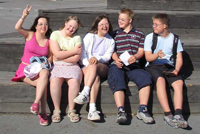
This is where the expression "Let's pretend" comes in. Whilst other pupils come home with their school-bags weighed down with books and information about various subjects, as well as projects and learning goals, Jenny and her friends return home with nothing in their satchels. They are denied the pleasure of being able to show anything to their families and friends.
Jenny is entitled to be treated seriously and she should not be patronised by becoming a "let's pretend" pupil. She learnt to read in her second year at school. She happens to be the one in our family who devotes the most time on reading books. Besides this, she enjoys taking on responsibilities. She is enthusiastic about week timetables and schedules over different leisure activities. She is always proud to be able to present completed tasks, as well as home-work. Because they are so motivated and willing, Jenny and many of her friends may even have a greater potential, possibilities to absorb and learn new and exiting matters. They appreciate being "real and proper" pupils.
They are also fully occupied being like other youngsters. That is why parents nod proudly to each other when they tell stories about how their teenagers contact each other by telephone-texting (sms, e-mail or when they secretly close the door behind them when they make appointments for snacks and movies on Friday evening.
That is why parents shake their heads in resignation when they are met with the sight of the empty schoolbag.
Jenny and her chums astonish both us parents and others in the way they achieve new skills, which we doubted they would ever manage. This has resulted in us becoming aware that there is no limit when it comes to learning (which has been confirmed by British research carried out by Buckley, Bird, Sacks, Archer (2002). [1] These refer to very good results due to increased efforts in the teaching of people with Down syndrome.)
There are, of course, some differences between Jenny, her friends and the rest of us. However, we are like each other in most matters of being human beings; we have the same basic needs. Hopefully, the following story will illustrate this.
The other day I was fortunate enough to be present when a conversation between Professor Arne Naess and the author Petter Mejlaender took place. Many different issues were discussed, and the conversation turned to Naess' childhood and schooling. He was definitely not a model pupil! He played truant and opposed his teachers. Nevertheless, he had fond memories of school, because he experienced that his teachers had an eye for him and acknowledged him. He also overheard them referring to him, saying "well, there is something to him" and this was said with a twinkle in the eye.
There is also something to Jenny and her friends! Each one of them is in possession of a unique personality, as well as their abilities and resources. They, like any human being, need to be acknowledged that there is "something to us all" and that we are all worthy of expectations.

The empty satchel signifies that there are no expectations when it comes to Jenny and her friends and therefore no timetable, books or structural curriculum are necessary for them. Why does it have to be like this? Is it because this group of pupils is burdened with the stamp of being unteachable? If this is the case, the large amount of money designed for gaining more knowledge and expertise in education would be better put to eradicate the myth that pupils with mental disabilities are unteachable. Resources should be put in to developing structured curriculum and assessments for this type of student. Otherwise we will not achieve the Government's aim of having inclusive schools in Norway.
Jenny and her companions may not be rewarding in that they are unable to contribute in the international school competition of getting best results in subjects like reading, writing, arithmetic and digital skills. Jenny and company will not increase the average result. Perhaps this is why investment is not used on this kind of pupil? Is this the reason why development of specially trained teachers is hardly considered, although a tremendous effort for developing skills and knowledge is being made for employees in the rest of the education area.
Our (former, new government now) Minister of Education, Kristin Clemet, is constantly claiming that she is an eager disciple of the inclusive school. I believe that many parents of pupils with reduced learning abilities experienced a glimmer of hope and optimism when she talked about the need for establishing quality within education. At the same time she was also occupied with the aspect of human diversity. That spark of hope was soon extinguished during Mrs. Clemet's first year in office when we experienced a fading interest in our children. Pupils with special needs are barely mentioned in the new Act of Education. They have become invisible.
Dear politicians - you have recently come through an election and voters have provided you with new possibilities for you to strive for a society which will include all of us. Which of you is willing to work towards a system of education which will focus on everyone, including Jenny and her friends. Which one of you is prepared to treat them seriously, without performing the "let's pretend" game?
Which one of you will see to that they receive systematic training which will strengthen their self-esteem, and through well-planned tuition, enable them to rely on their own abilities?
Can you hear us?
Do you see Jenny?
Article first published in Aftenposten, 16 September, 2005.
Reference
- Buckley, S., Bird, G., Sacks, B. and Archer, T. (2002). A comparison of mainstream and special education for teenagers with Down syndrome: Implications for parents and teachers. Down Syndrome News and Update, 2(2), 46-54. [Open Access Full Text]