







Our journey with Hirschsprungs
How one family have coped with their son's intestinal disease, a condition which has left him incontinent for over ten years
Wong, S. (2006) Our journey with Hirschsprungs. Down Syndrome News and Update, 5(2), 65-68. doi:10.3104/practice.364
When our children are little we discuss every aspect of their lives; are they sleeping through the night, do they feed well, do they still wear nappies, how did you potty train yours? Every parent, or mother at least, takes pride in the child who sleeps though the night from two weeks old, or accepts the sympathy for the relentless broken nights. We secretly gloat at the poor parent who hasn't yet managed to get their three year old out of nappies while offering sympathy and useful hints that worked for our brilliant offspring.
When you find yourself bringing up a child with a disability, things are different. How many parents still talk with pride about potty training a 5 year old? Who wants to hear about the constant round of washing smelly clothes and bed linen because nappies don't quite hold everything in like they used to? When the child gets to 11 years old and is still soiling even fewer want to know.
In my own experience, the most isolating thing about raising my son has not been his learning disability, the hearing impairment or the poor speech development, all these things lend themselves to sympathy. The most isolating thing has been that he has a bowel condition that has led to a lifetime of soiling, no one wants to talk about that. It's a real conversation stopper!
My youngest son has Down syndrome, he also has Hirschsprung's Disease, a condition that means he was born without the nerve endings in his colon that ensure everything keeps moving along as it should. It is a life threatening condition if not treated and is usually picked up in the first few days after birth. Treatment usually means surgical intervention and removal of the affected portion of the colon but the long-term consequences can lead to a lifetime of constipation or diarrhoea, susceptibility to bowel infections and to problems with soiling and faecal incontinence. I am going to break a taboo now and talk about life with a child for whom toilet training simply hasn't worked. I'm going to talk pooh!
I have three children, Ben and Naomi, who came to me through the traditional route of conception, pregnancy and birth, and Tim who came into our lives at 15 months old through the less traditional route of foster care and adoption.
Tim, or Ben-Ben as he was then known, arrived on our doorstep aged 15 months. He was a tiny round bundle of gummy smiles and cuteness. We'd been asked to foster him as it was felt he, out of all the children in the children's home where he was living at that time, would benefit the most from a family home, as he was 'medically fragile.' At this time we were living in a twelfth floor flat in a housing block in Causeway Bay, Hong Kong.
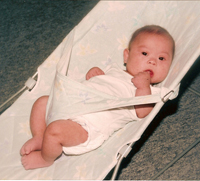
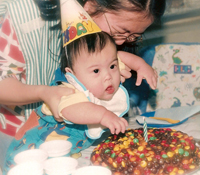
Ben-Ben's first birthday
Ben-Ben had been born with Hirschsprung's disease in addition to Down syndrome. He had had corrective surgery as a new born baby and was now waiting for the final stage of the corrective surgery - the reversal of his second colostomy - which, we were told, would take place in a couple of months time. We were told not to expect too much from him (apart from those gorgeous gummy smiles!) as he was, in the opinion of the professionals working with him, severely retarded and medically fragile. When he joined our family at 15 months old he couldn't sit unaided, crawl, hold objects in his hand, he made no sounds other than to cry or laugh and was, as we had been told, often ill.
I had been asked to take Ben-Ben because I had a nursing background and in view of his medical problems and the colostomy, it was felt I had the necessary skills to deal with him. However, I learnt extremely quickly that changing the colostomy bag on a consenting adult is a vastly different, and far easier, procedure than changing the colostomy bag on a squirming, hungry, very unhappy and uncooperative infant! If his hands weren't roaming over his tummy and stoma (a stoma that had pooh producing qualities that Mount Vesuvius would be proud to own), then his legs and feet were in it. He was like the original human rubber baby, moving in every direction except the one I wanted! That first night it took me two hours with Ben-Ben screaming in one ear, my older children crying because they were also tired and hungry in the other ear, only to find the bag had leaked within a few hours, so that the whole process had to be started again. Round one to baby's stoma! Looking back at his colostomy days the one thing that really sticks with me is the smell. A pooh filled nappy is one thing, but the stink of a leaky colostomy bag is something else, it is indescribable to those who have never experienced it.
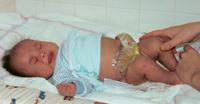
The day after Ben-Ben arrived I went shopping to a well known children's toy shop chain and bought a baby gym and two toddler restraining straps. This proved to be a lifesaver at colostomy clean up times. It sounds like medieval torture now but it reduced the changing time from 2 hours to 15 minutes immediately and then gradually down to around 5 minutes. The gym was set up over Ben-Bens head to engage his attention, the toddler straps were attached to the top of the gym and then these were attached to Ben-Bens hands, thus reducing the movement of his hands. He was still free to play with the gym but couldn't reach his stoma. At the same time, I pinned his legs between my legs and got on with the job in hand. Round two to me!
Some things that caught us out were not directly related to the Hirschsprung's, more a side product of the treatment he'd received. All the surgery he'd received and the frequent bowel infections meant he had an intolerance to lactose and so needed soya baby milk. He had only been weaned a few months when he arrived and was used to bland baby mush, but he demanded real food mush. So I obliged, but made the poor child ill as his system wasn't able to cope with the rapid change in diet. However, once recovered, he quickly adapted to real food and consumed vast quantities for one so small, a trend that has continued to this day. I had read that children with Down syndrome have a slower metabolism than typically developing children and that there was a real tendency for them to put on weight easily. However, it turns out that Ben-Ben's phenomenal appetite was as a result of an over active metabolism and so between that and regular exercise he has always remained a healthy weight for his height. His ability to consume vast quantities of food remains a talking point to this day!
Another problem was gas. He couldn't burp without a lot of help and all that gas had to go somewhere! He suffered with dreadful colic way past infancy and could produce enough gas to power a small car. During the colostomy days, he would wake in the morning with what looked like an enormous tumour on his abdomen, the result of a colostomy bag full of gas and ready to burst (which periodically it did, not pretty!). Burping is a skill he has only recently acquired and is still not reliable. Gassy drinks have to be limited as does the speed with which he prefers to eat his food! It is only a recent development that we have not had to physically restrain him from eating too fast, these days a reminder will usually suffice.
In my naivety, I thought that closing the colostomy would lead to more normal bowel habits. However, this was not to be the case. While the diseased bowel had been removed in the first operation as a baby, because of the nature of Hirschsprung's disease the rest of the large colon was also abnormal, while not actually having any of the diseased bowel left. However, I was not told this until much later. I eagerly looked forward to an end to the smelly bags and to having a sweet smelling baby.
The reversal of the colostomy took place two months later than originally anticipated because Ben-Ben contracted pneumonia and then, almost as soon as he was released from hospital, he caught chickenpox from his sister. As a result of the chicken pox he spent another week in hospital with septicaemia. The colostomy closure finally took place in July 1995 when Ben-Ben was 20 months old. The surgery was successful and straight forward and Ben-Ben was discharged home early, ironically because of an outbreak of chicken pox on the ward!
I remember a Chinese grandmother visiting her son in the bed opposite Ben-Ben's. Her grandson also had Down syndrome and for two days this lady just sat and watched us, not quite able to work out the relationship between Ben-Ben and myself. One day she came over to Ben's cot and sat stroking his hand and then quietly turned over his hand and on seeing the single crease in his palm got really excited 'yat yeung, yat yeung' (the same) she repeated several times, very pleased with herself to discover her suspicions had been right!
After the surgery, I was warned to expect a week or two of frequently soiled nappies so I wasn't unduly concerned by the 14 or so nappies we went through in a average day. A month after his surgery the soiling became more frequent, he was in obvious pain and the faeces had turned green, so it was back to hospital with a bout of gastro enteritis. Children with Hirschsprung's disease are more prone to bowel infections than other children, with a higher than average mortality rate so this was a worrying time. Those first few years I worried about every temperature, every time his abdomen got bigger than it already was, any sign of a tummy bug and Ben was whipped off to the doctor. But although I panicked at any sign of ill health, Ben-Bens health actually improved enormously after the surgery. Since that bout of gastro enteritis he has only been admitted once with another bout of gastroenteritis and rarely has any tummy bugs. He still was fragile in that he caught every cold, cough and other viral infection going, but he never again needed hospitalisation for them.
By 3 months post op Ben-Ben was still going through 14 or more nappies a day. His poor bottom was raw but traditional methods of helping healing, like leaving the raw bottom open to the air, were not a realistic option given that he was almost continually soiling. He still smelt bad most of the time no matter how often his nappy was changed. Doctors could give no practical help and so I turned to the internet, newly acquired in our home, and sought out support groups for both Down syndrome and for Hirschsprung's. The Guardian society, the HD support group, was an invaluable source of help and advice. I was given advice on how to adapt Ben-Ben's diet to help solidify the faeces a little and was advised to try enemas as diarrhoea is often as a result of constipation. Microlax enemas proved to be a very helpful intervention and the soiled nappies were reduced to only three or four a day with no soiling in between. His bottom healed up but remains very prone to breaking down to this day if soiled nappies/clothes are not removed very quickly. His surgeons in Hong Kong were not over happy for me to 'go solo' so to speak with regard to treatments but offered no alternatives other than giving it 'time to settle' and said that the enemas would do no harm, so we continued with them for several years, until our return to the UK, by which time Ben-Ben had become Timothy (Tim-tim!).
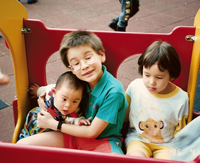
Ben-Ben with his brother and sister
When Ben-Ben was 2 years old I read a very depressing research article that suggested that children with DS and HD rarely achieve full faecal continence without surgical intervention. That the best chance of success lay with a strict regime of toilet training. I bought a potty! He was started on a rigorous training programme and while he did manage to use the potty from time to time he was still faecally incontinent. He did achieve urinary continence though so at least the nappies were dry!
In 1997, 8 months after his adoption, we returned to the UK. The educational opportunities available were not that good for Tim (as he was now known) or for his elder brother and so we came back for better opportunities. Tim was enrolled in his local infant school with 25 hours TA support and we found new doctors.
His new doctors did not approve of the microlax enemas and, as they were beginning to be less effective, Tim was started on a series of different medications over the next 5 years or so. The constant theme was that he was constipated and that that was why he was still soiling himself so he endured stool softeners that produced very runny and extremely sticky faeces. Laxatives that induced terrible stomach cramps, but nothing that really gave any real relief from the constant soiling. There were periods of time, sometimes lasting several weeks that lulled us into a false sense of hope, of continence, but they never lasted and one day he'd just start soiling again. No pattern ever emerged, no food could be pin pointed as the culprit though several were found to make the problem worse (sweetcorn for one). His new surgeon, though concerned, was mainly of the opinion that he was constipated and that he needed toilet training. As Tim had been subject to a very strict toileting routine since he was 2 years old I knew training wasn't the answer!
And so we went on year after year. The problem affected every decision we made, where we could go, who we could leave him with, after all many people will willing change a soiled nappy on a 2 year old, but a 9 year old? I redecorated the house with laminate floors - the carpets stank where he'd sat on them with leaking nappies, the sofas were swopped with leather ones for the same reason.
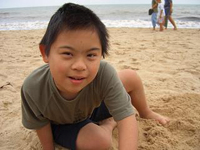
Tim at 10 years old
Then, one day when he was 10 years old we were offered a real hope of a treatment that might actually work. He'd been to see a growth specialist (he is also very small for his age, unrelated to the HD) who asked if we'd ever heard of the A.C.E. procedure. He described a small stoma with a valve on the inside, rather like a gastrostomy but made in the top end of the colon. Through this a small tube (catheter) could be passed and an enema could be given top down rather than bottom up, and that this procedure had been found to have a high success rate in controlling faecal incontinence. I approached his surgeon with this suggestion but met with resistance to the idea, so we continued for another year with different medication.
By the time Tim was 11 years old he was still soiling up to 6 times a day. He had now begun at a special school and the boys, many of them with autistic spectrum disorders, were not as kind to him about the smell as the children he had been at school with since reception. One day he came home crying that he was a dirty smelly boy and he threw his nappy in the bathroom sink in disgust. His surgeon finally agreed that it was time to try the surgical route and so I discussed with Tim his options. Stay in nappies or try an operation to try and get him out of nappies. Despite his learning difficulties he had no hesitation in saying he wanted to have the surgery and so he was booked in for August 2005.
The surgery went ahead without a hitch and he had his first washout just days after surgery, though this first time was a rather messy affair, not helped by the distance of the hospital toilets from Tim's bed! After the post op catheter was removed (10 days post op) I then had to catheterise him every day with a size 8 single use urinary catheter, flush 200 mls of saline and one fleet enema through the catheter and then Tim had to sit on the toilet for an hour for the best effect.
The first hitch was how to keep an impatient 11 year old boy with learning difficulties on the toilet for an hour without strapping him down (remember the colostomy solution?!). His love of, and ability in, reading came in very handy here. We went on a special shopping trip to buy a new CD player and several Horrid Henry talking books. Horrid Henry talking books are conveniently one hour long, perfect, plus he gets to practice his reading skills for 60 minutes every night! Initially, he struggled to keep up with the reading but he is now able to follow the story in his book as it is read. The benefits of multiple readings have developed his comprehension of the stories though it has to be said that I am personally getting sick of the theme tune and have started his new library of Roald Dahl talking books for a change!! His hearing impairment means the tapes are always played loudly!
And so, has the surgery worked or not? Well, initially there were some problems with a small wound infection (one of the potential problems we had been warned about), and if he didn't sit on the loo for long enough he would soil in the night, but over all the success has been phenomenal. I couldn't have predicted a better outcome. From around the second flush (the saline/enema cocktail) we braved real under wear. After he was discharged from hospital, Tim and I took a special trip to Asda and he chose 12 pairs of boxer shorts, the position of the stoma rules out briefs. He is so proud to be able to wear these. We have had a handful of small accidents, mostly at night, usually the result of too short a time on the toilet.
There have been a few related problems. The stoma began to seal over in between catheterisations, so I started to leave the catheter in all the time to keep the stoma open, this in turn led to the skin becoming very sore from the repeated application of sticky tape. It also led to a small amount of leakage from the stoma onto the skin and so made the sore skin worse. So another product, Cavalon, was applied to act as a barrier to the skin. In the last few weeks though the stoma has been more stable and no longer seals over as readily and so the catheter is only occasionally left in over night.
Tim has also adapted to the extent that we can manage his flushes every other day (as long as I still catheterise the stoma each day). The flush is slightly larger, 300mls of saline instead of 200mls, but it works fine and he is still clean. And one big surprise for both myself and his surgeon, within a few weeks Tim was able to catheterise himself and to flush the enema solution through the catheter himself. No one thought he'd be able to do this. He's a long way from independence in doing this but it's a start and gives me hope that when he is older he'll be able to manage this procedure by himself with minimal supervision.
So, a long road but with a good outcome. To say that Tim is continent is not strictly accurate as that would require an element of real control on his part, however, he is clean and there is a possibility that he will acquire true continence in time.
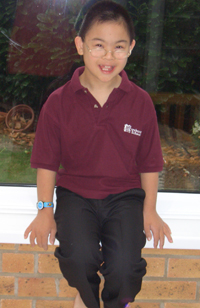
Tim's first day at secondary school
To say Tim is continent is not strictly accurate; however, he is clean and there is a possibility that he will acquire true continence in time
And one extra benefit from this procedure; Tim is now able to wee standing up, a real accomplishment for a child who needed to sit previously as he always opened his bowels when sat on the toilet before the surgery. And a second benefit for the family, the problem with gas has greatly diminished, so it is rare that we are subjected to nasty niffs!!