






An update on the developments of the Down Syndrome Support Group Bradford
Development of a parent-run service in the north of England
Uttley, W. (2005) An update on the developments of the Down Syndrome Support Group Bradford. Down Syndrome News and Update, 5(1), 20-22. doi:10.3104/practice.355
Over the last year, our group has grown from strength to strength with over 80 families and approximately 50 interested organisations, e.g. schools, childcare, and health services on our mailing list.
We thought it would be a good idea to let members of The Down Syndrome Educational Trust read about what we've been up to and what plans we have in place for the coming year.
A Group Coordinator
Our first big change came in July 2004 when we received funding from Bradford Children's Fund to employ a Group Coordinator, me. This saw many changes in the running of the group since I had to stand down from the committee. At the same time, we decided to apply for charitable status. Much paperwork later, we emerged after our AGM in November 2004, with a strong, enthusiastic and well-qualified committee, a new constitution and, by December, registered charitable status.
The first part of this year was spent applying for funding to maintain the position of Group Coordinator. Our application to BBC Children in Need to fund the position for the next three years was unsuccessful, however Bradford Children's Fund have confirmed that they will continue to fund the position in the near future. We are also awaiting the result of a funding bid to the Big Lottery Fund to fund the post plus two conferences and further speech and language sessions, which is the next thing I want to tell you about.
Speech and Language Therapist
After many years of placing pressure on our local Speech & Language Service, with very little result, I spoke to David McConnell, a trustee of The Down Syndrome Educational Trust, earlier this year and followed up his suggestion that we find and employ an independent therapist - it took us about one week! We applied for funding from the Local Network Fund to fund monthly speech and language sessions for a year and were successful. We have just finished organising these sessions and one Saturday per month two therapists will spend 6 hours delivering training, group work and one to one consultations for the members of our group. There will be four groups on offer hopefully to cover the age range and ability of the children. Training before the sessions will explain the aims and any theory behind the methods being used in the group sessions. We also plan to have resources ready for families to take home so that they can continue the input at home.
We are encouraging learning support staff to attend alongside parents and we hope that the sessions will empower the adults working with children with Down syndrome, giving them the confidence to plan and deliver activities to promote good speech and language development.
Training courses
Another development, gradually evolving over the last year or so, is the development of training courses for parents and school staff. Again, we have been placing pressure, this time on Education Bradford, to develop specific training for school staff working with children with Down syndrome. We have been partially successful in that two courses have been delivered this year. However, we wanted more - a full package for teaching staff. My confidence in offering training has grown since developing and delivering the course "Teaching Numeracy to Children with Down Syndrome Using the Numicon Approach". I had delivered this course many times, including at two conferences when I was, by chance, contacted by a member of the Teacher Training Department at Bradford College who had been commissioned by Education Bradford to visit the special schools in the area and ask them what training they needed. I immediately jumped on the fact that this was not including training for mainstream staff and stressed how much of a need there was in this area. As a result I set to and using the relevant Down Syndrome Issues and Information booklets developed a half day course "An Introduction to Down Syndrome" and on June 24th I delivered the course for the first time at the Department of Teacher Education, McMillan Building, Trinity, Bradford.
The classroom was full - 23 in all from various schools in the region. The majority of participants were learning support assistants, others were teachers and a SENCo. The 3 hour session covered;
- Society's view of people with Down syndrome
- What Down syndrome is
- What difference the extra chromosome makes - looking at some health issues that may affect educational development
- The specific learning profile - discussing strengths and weaknesses in the classroom
- Ideas and guidance on differentiating the curriculum and developing a visual approach to teaching and inclusion.
I had so much to say that I ran out of time!! And did not cover ICT or behaviour. However, feedback was very positive with all participants asking for more training.
The course will be offered again on 23rd September 2005. Following the success of this course, I have been asked to develop a follow up course and this will take the form of 4 evening sessions. I have decided to call this next course "Down syndrome: Signing and other visual methods". This course will introduce signing and develop other visual methods alongside reinforcing the importance of providing visual instruction, communication and learning opportunities/activities for pupils with Down syndrome and other visual learners. It will cover:
- Signing - why we use signing with children with Down syndrome
- Relevant signs to aid communication and language development
- ICT - why this is such an excellent resource, demonstration of some software packages and an opportunity to make your own resources using Publisher and/or Word
- Using the written word as a visual aid - ideas on how to use the written word to develop vocabulary and grammar
Then on 4th November a full days training on "Teaching Numeracy to Children with Down Syndrome using the Numicon Approach" will be delivered. This course will cover:
- How children learn numbers
- Numicon foundation kits-activities for early development
- Numicon activities for year 1 mathematics
- Introducing money and the concept of time
- Relevant software demonstration
I am very pleased to have the opportunity to deliver this training, although the development of the courses has been (and still is!!) very time consuming. Booking forms and further details are available on our website.
Early Development Group
We are also hoping to start an early development group, "Fun & Learning" from September 2005. Sessions will be 2 hours long and run weekly over a period of six weeks. The first part of each session will focus on developing early education skills, the second part will provide an opportunity to make resources such as word cards, post boxes, magic bags etc to help support activities at home. A programme of activities is available from our website.
Family support and learning
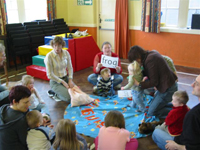
Since our group was established in September 2000, it has continued to meet one Saturday morning per month at Haworth Road Methodist Church, Bradford. Our meetings are always well attended with some families travelling from nearby towns and cities to visit us. During our Saturday mornings, we try to provide learning activities, singing/signing sessions for the children, a relevant visitor for parents, for example one month we had the continence nurse, and of course, the opportunity to meet each other and share news and experiences.
We now have many young families in the group, approximately 25 have children under the age of three. Consequently, our activities tend to cater more for the younger children, leaving the older children to sing along with "the wheels on the bus" and other activities for the younger children or to play with siblings and join in an activity provided for older children. However, experience has shown us that this does not really work since a number of older children with Down syndrome faced with the choice of playing/taking part in older activities or playing with the babies' toys tend to opt for the latter. For this reason and also the commencement of our monthly speech and language sessions, we have decided to split the group.
Two age groups
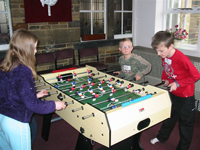
So, from September 2005, one month will be for younger children with Down syndrome and their families and the next for older children and their families. This is very exciting for us and at present, we are busy thinking up learning activities to offer the older children and their families. Some activities we are planning are group games using Numicon to help learn to tell the time and use money and shopping; expecting children to queue up and pay for their own snack and pour out their own drink. We have recently purchased a full size football table and plan to buy an indoor basketball game. We hope these sessions will provide the opportunity for children with Down syndrome from approximately the age of 7 upwards to form friendships with each other which, in turn, as they become teenagers, may provide the opportunity for them to go out and about together as other typically developing teenagers do.
As a group, we are very proud to feel that we are working towards making a difference to the inclusion of children with Down syndrome in and around the Bradford area. There is still much to do but we feel that we are on the right path; a path that is very exciting for both ourselves and our children.
Information on all of the above developments is available on our website