







Number fun? You can count on it!
Emma explains how she devised a range of fun-packed, differentiated numeracy activities for seven-year old Richard. She also describes how she extended some of the activities that she began using as part of the Numicon project with Dr Joanna Nye.
Saunders, E. (2004) Number fun? You can count on it!. Down Syndrome News and Update, 4(1), 11-14. doi:10.3104/practice.326
I was asked to write an article to explain some of the numeracy activities that I have planned and delivered for Richard over his three years at infant school. I have tried to explain the range of activities that we have come up with and how I tried to fit them to Richard's specific profile of needs, his likes and his dislikes. I have described four main areas of work that I have focused on with Richard including learning the Numicon shapes, number bonds and early addition, money and time. Before discussing the activities, let me tell you a little bit more about Richard and myself.
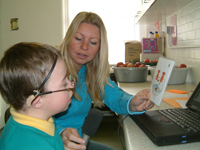
Richard and Emma
A little bit about me…
I qualified as a nursery nurse in 1989 and since then have worked as a private nanny and within nurseries and playschools with children aged between 6 months and 5 years. I have spent the last 4 years working in mainstream infant schools supporting children with special needs including language pragmatic disorder and cerebral palsy. For the last 3 years, I have been supporting Richard, who has Down syndrome. He also has bilateral moderate hearing loss and uses a bone conductor hearing aid. Richard also has a visual impairment and wears glasses.
and a bit more about Richard…
Richard is a funny, affectionate, caring and wilful 7 year old who knows what he wants! Over time he has formed some special friendships with certain children in his split Y1/Y2 class, most of whom happen to be Y1 children, though at playtimes he enjoys joining in games with other children. Nearly every child in the school knows Richard by name and you hear frequent cries of "hello Richard".
Richard tends to use one and two word phrases in his expressive language, although he can understand sentences containing three information-carrying words, e.g. "put the horse in the box". He is learning Makaton and Richard and I use signs to help us to communicate and show each other what we mean.
Richard's numeracy skills have gradually progressed over the three years that I have worked with him. In this article, I have focused on the work we are doing with the numbers from one to ten as we are still working to consolidate his understanding at this level. However, this does not stop us from participating in and enjoying activities with numbers greater than ten with the rest of the class. For example, Richard loves joining in the counting with his classmates before each numeracy lesson. Richard is also able to count in twos. He has recently learnt how to copy some of the numerals to 10, some of which he can write independently.
Using Numicon
Along with 15 other children with Down syndrome in the local area, Richard participated in the Portsmouth Numicon project, co-ordinated by Dr Joanna Nye from Down Syndrome Education International. The study ran for twelve months and involved working for 10 minutes per day, as part of the numeracy hour, carefully progressing through the Numicon activities. We were supported by Jo, who visited us every half term and also ran workshops from the Sarah Duffen Centre. Jo encouraged us to not only to stick to the structured activities as outlined on the activity cards, but also to integrate the use of Numicon materials into other numeracy activities within the classroom. I went a step further and decided to take Numicon into the playground!
Make a pattern
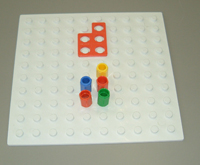
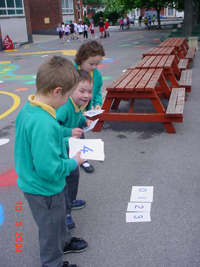
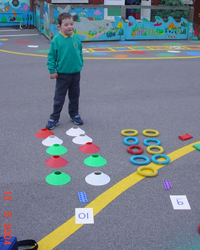
The photos below illustrate an activity that I designed as an extension to Activity 5 (Make a pattern) from the Foundation Stage Numicon Scheme, which aims to help the children to become familiar with the Numicon shapes. This activity involves showing the child one of the plates and asking them to make the same pattern using pegs on a board. We took this activity a step further. Richard chose two friends to help him and we took a variety of games equipment into the playground. The children took turns to lay out large number cards in a number line and then Richard put the appropriate Numicon plate under each number. Next, the children took turns to choose beanbags, quoits or markers to make the same pattern as the Numicon plate underneath. Richard demonstrated this to the children, as this is something that he uses regularly and is familiar with, therefore providing an excellent opportunity for him to take the role of teacher and develop his self esteem.
Helping hands
The next activity was based on a class activity where the whole class made handprints and numbered them in 5's up to 100. I had noticed that during whole class work where Richard's teacher asks the children to show "How many?" in response to simple addition sums, Richard sometimes has trouble holding up the correct number of fingers. I thought that we could use the handprint idea to give Richard some extra practice and understand the "How many?" question more successfully.
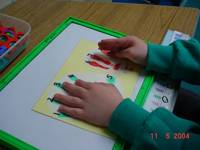
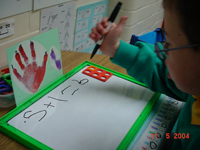
Richard printed his hands and, with some help, cut them out. I made them into laminated cards, each card had a "5" handprint and then single fingers up to 10. Written above each finger was the number they represented. On the back was the sum you could make up i.e. 5 + 1 = 6, 5 + 2 = 7. See pictures below.
Playing the game
Richard selects a card, and then copies the handprint with his hands/fingers, by placing them on top and matching (see picture below). I would also hold up my fingers and say the sum 5 + 3 = 8, and count saying 5 and 3 makes 8. Richard then turns the card over to see the sum. Using a wipe board and pen, he copies the sum independently, (something that he has achieved quite recently). As a further visual reinforcement, I have the Numicon plates ready for Richard to look at. I ask if he can find 5 and 3 (or red and yellow) and encourage him to fit the plates together and the see what new pattern they makes. Then I'll ask him to find the plate that is the same as 5 and 3 together, i.e. the 8 plate, "Can you find the same, number 8?"
How many ways to make 5 ?
This activity was drawn from a Yr 1 worksheet, which showed 5 cut out pears with 2 plates. The children had to make a sum of 'how to make 5' using the pears and then to write the sum. I made the food 'currant buns', as Richard loves the song. I also made the plates much bigger, the squares for Richard to write the numbers in were enlarged and I laminated the sheet so that Richard could use it time and time again, and to give him confidence using the wipe pen. The laminated card was particularly practical when we first started using this activity, as Richard needed lots of practice to write the numbers. The laminated card allowed us to wipe them away quickly and easily.
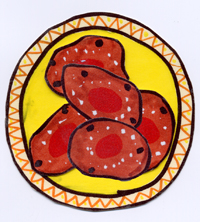
1 + 4 = 5
I also used a number line in this activity, to help Richard with copying the numbers. When we first introduced the activity, I used to write the numbers in 'dot-to-dot' to help Richard to become familiar with the numerals.
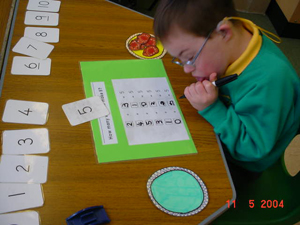
We sometimes use the currant buns to 'go shopping' and sing the song, taking turns in buying the buns for 1p, 2p, and 5p coins. See Richard's toyshop activity below.
Ways to make 10
As Richard gained confidence with 'ways to make 5', we played the game in the same way, but using cut out sweets, and a pack of number cards up to 10. We turn the cards over one at a time, to decide how many sweets the first person gets.
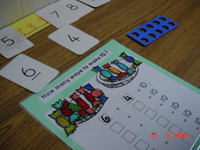
Lets go shopping
The following activity develops Richard's pretend play, speech and language and money skills at the same time. Richard has his own special "toyshop" with toys brought from home and from school. Each has a price tag with the coinage stamped on the back to give a further visual clue. There are three shops; a 1p, 2p and 5p shop with toys that Richard selects and puts into his shopping basket. When he's selected his toys he comes to my till and pays using "real coins". I only put the three different coins in the purse for Richard to select from, but as Richard gets more confident, the prices will increase and there will be more coins to choose from.
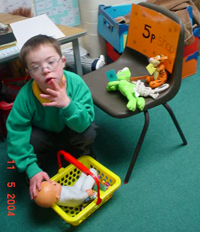
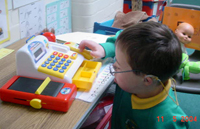
Richard's 5p shop and till
There is lots of scope for language with this activity i.e. "How much?" "What can I buy for 2p?" and the names for all the character toys. We usually play this activity prior to the whole class learning about money. The money worksheets are simply changed to 1p, 2p and 5p denominations and simple pictures of Richard's toys are drawn with the prices attached for Richard to match other price labels to.
Time
Richard's class have been learning about time during numeracy. Every child has an activity 'time pack' and Richard's pack was adapted to suit him, though some of the worksheets were clock faces that simply needed enlarging and made into o'clock times rather than half past etc. Richard started off by making a clock using split pins to attach the hands and cutting out the clock independently. He then had a large clock face where he had to fill in the numbers using dot to dot, and then draw in the clock hands to make 9 o'clock. A simple sentence was written underneath "I go to school at 9 o'clock", which Richard traced over.
Richard then went onto picture and time sequencing. He had to cut out and stick in simple pictures i.e. 'wake up', 'eat breakfast', 'go to school' and fill in the time ( … o'clock) that he does each thing in a normal day. We both used the Primary Time Teacher clocks to make the same time. We then looked around the school to find simple props to do some acting. Once we had a practice, acting out the story of 'Richard's day' using props like a pillow, bowl and spoon, school bag and bell, Richard put on a little performance for his class, to show them what he had learnt about time. He even took a bow at the end!
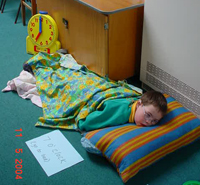


Richard's day: 7 o'clock - go to bed; 8 o'clock - breakfast; 3 o'clock - time to go home
Another time activity that Richard enjoyed was matching the Makaton signs for the days of the week to the written words.
Moving on…
Richard will be leaving the infant school this summer and moving onto the Juniors in September. The transition has been well planned, with opportunities for Richard's new LSAs to come over to the infant school and learn about the ways in which we have differentiated the curriculum for Richard, e.g. incorporating visual prompts, using practical activities such as role play, ensuring that the work is meaningful for Richard and set in the context of familiar experiences from his every day life and most importantly ensuring that the work is fun so that Richard is eager to try every activity. I have been lucky in that I have had excellent working relationships with all of Richard's class teachers and I feel that good communication between us has been vital to help us understand Richard's changing needs, and decide on appropriate targets for him. We have struck a balance between time spent in and outside the classroom. Every child in school spends some time on one-to-one work outside the classroom and this means that it has not felt unnatural for Richard and I to work, one-to-one, on his specific speech and language, literacy and numeracy targets at regular points during the school day. There isn't always time for me to create differentiated resources for Richard and sometimes I have had to do this in my own time. However, as Richard gradually becomes more independent, there should be times when his assistants at the Junior school can take a back seat for a while in order to work on resources for future activities. This is also important for Richard's development in terms of fostering his independence, self-esteem and self-help skills.
Richard has visited the Junior school several times and at present seems unperturbed by the impending change. The next issue of Down Syndrome News and Update will include details of how we designed a social story to prepare Richard for a change in assistants while I was on holiday, which we felt may have triggered changes to his behaviour if we had not planned for it in advance. We hope to use a similar technique over the final few weeks to help Richard's transition to Junior school. Richard's transition has also prompted a change for me too and I am currently looking for a new challenge working with families and children with special needs.
Emma Saunders is a Special Needs Assistant working in the UK