







The Girls' Club
The Girls' Club
Sneath, G. (2006) The Girls' Club. Down Syndrome News and Update, 6(1), 17-18. doi:10.3104/essays.376
"The Girls' Club": It's like a birthday party every month - only better ! And what could be better than a birthday party? Well, most birthday parties for school age children involve the special friends that children see every day at school, with perhaps one or two friends from elsewhere.
"The Girls' Club" is different.
Our girls all attend different schools in the Auckland metropolitan area, where they enjoy the benefits of mainstream schooling, with teaching support, and mainstream role models providing a high level of social inclusion. Even so, as our girls have progressed though the primary school years the nature of school friendships and school relationships have changed and evolved. It is becoming more difficult to maintain close friendships outside school hours. Now at the ages of ten to twelve years the timing is just right for the development of a network of special friends who meet up at least once every month for celebrations, activities and friendship strengthened by the common bond of Down syndrome. It is hoped that "The Girls' Club" will provide opportunities to practice social skills and cement friendships that the girls could take into their teenage years.
"The Girls' Club" was instigated through the foresight and dedication of Karen Knight and Linda Easterbrook who worked to set up a series of fun and interesting activities which the girls could share and succeed in, while they enjoy making new friends and strengthen bonds formed by the experiences they have in common.
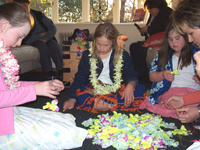
The girls making Hawaiian garlands
Monthly activities for the girls have included the usual children's party games plus activities centred on hand-crafts and art. "The Girls' Club" have enjoyed the excitement of anticipating seasonal activity themes based on Halloween, Christmas and Easter, where together they have made cards, decorations and small gifts. "The Girls' Club" have shared in the preparation of cakes or pizza for the Friday night feast. Sometimes it is just a celebration of traditional Friday night's fish and chips, with more time on other activities. The summer months have allowed for pool parties and outdoor ball games. Team sports or board games and card games have not been explored yet, but no doubt the opportunities are endless for promoting good leisure and social skills.
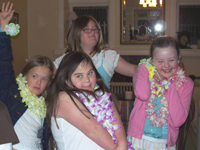
Hawaiian night at The Girls' Club
"The Girls' Club" is a chance to interact with peers who share a similar level of abilities, sense of humour and interests, in an environment that is well controlled yet relaxed and comfortable. Keeping the group to a small and manageable number (maximum of 10) has been a deliberate strategy to ensure the girls have a chance to get to know each other well, and to engage in activities that can be arranged within the home.
"The Girls' Club" meet on a Friday evening after school, and although now it is working on an informal roster, Karen bravely hosted all the early sessions. The format requires a formal invitation, with a letter to each of "The Girls' Club" members. The invitation, which is typed or hand written by the host girl, gives not only the time and place but also a summary of the theme and general activities for the forthcoming 'Club Night'. It is signed, stamped and then duly delivered by New Zealand post, although occasionally a hand delivery might give rise to the opportunity for an informal social visit. A formal acknowledgement to the invitation is usually the required etiquette, with response by either telephone or written reply.
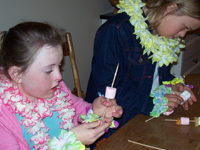
Making fruit and marshmallow kebabs
As members of the Auckland Down Syndrome Association, there are opportunities for lots of other meetings and shared activities in larger groups. It used to be that the girls were shy and reticent about mixing when they met at larger social activities. It took a while to break the ice and get to know each other again following the last organised event. "The Girls' Club" has changed that! Recently it was very much evident that catching up with members of "The Girls' Club" heightened the anticipation and excitement of attending the special privilege of a night visit to the Auckland Zoo.
Trips to the movies, days at the beach, regular sports activities, hobbies and craft groups are all viable opportunities for teenagers and young adults with Down syndrome. It is hoped that through starting to develop regular social interaction now, the girls will be confident enough in their teenage years to organise their own leisure activities with minimal parental involvement. Activities during teen years could be shared with long standing friends from both mainstream school and "The Girls' Club". It may also be that regular functions are arranged in community halls, with activities for larger groups of teenagers - including both girls and boys.
For the time being, the regular meetings of "The Girls' Club" also provide a good social contact for parents. For these initial 'club nights' several parents stay to help with the activities. There is time to chat, share information and ideas. It is the same as any coffee group - just with a slightly different focus for the day's activity. As the girls' confidence develops, it is envisaged that greater independence will be encouraged by less parental support in activities, with perhaps parents meeting away from the host home.
Only time will tell how friendships and social bonds will develop, but for now there is reward enough for parents and children alike. Participation in "The Girls' Club" has provided a monthly social highlight and a source of great personal satisfaction for our girls.
Thank you to Karen and Linda for the foresight and the energy, not only to get the ball rolling but for keeping the momentum up. The girls love it, and genuinely treasure their friendships at "The Girls' Club."
Greg Sneath is a parent from New Zealand